



The Nordic curl might be the single best thing you can do for your hamstrings. It cuts hamstring injury risk roughly in half, builds the kind of strength that protects you when you sprint, and needs nothing more than a way to anchor your feet.
It's also genuinely hard. Most people, including trained athletes, can't do a full unassisted rep the first time they try. That's fine. It’s something where you can still get some benefit from easier versions, and is well worth building up to where you can do complete reps.
Here's what the Nordic curl is, why the research is so strong, how to perform it with good form, and exactly how to build up to a full rep if you're starting from zero.
What Is the Nordic Curl?
The Nordic curl is a bodyweight exercise that loads your hamstrings as they lengthen.
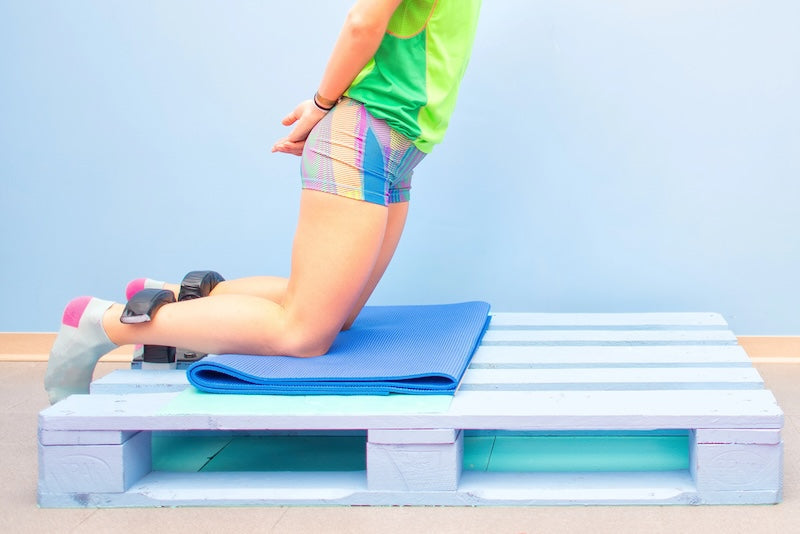
You kneel on a pad with your feet anchored under something solid, keep your body in a straight line from your knees to your head, then lower your torso toward the floor as slowly as you can. Your hamstrings take the load the whole way down. At the bottom you push back up with your hands and repeat.
That slow, controlled lowering is the eccentric part of the movement, where the muscle produces force while it stretches. Your hamstrings are working hardest exactly when they're most vulnerable in real life: long and under tension, the position they're in at the end of your stride when you sprint.
Your hamstrings are a group of three muscles (the semimembranosus, semitendinosus, and biceps femoris) that run down the back of your thigh. The biceps femoris (not to be confused with biceps brachii, which is what just “biceps” usually refers to) is the one that tears most often in sprinting injuries, and it's the muscle the Nordic curl trains most directly.
You'll also see this exercise called the Nordic hamstring curl, the Nordic hamstring exercise, or NHE in the research.
Why the Nordic Curl Is So Effective

This exercise is not an influencer-peddled hype job. Few exercises have this much high-quality research behind them. Here's what the evidence shows.
Cuts hamstring injury risk roughly in half
This is the headline finding, and it's about as strong as sports science gets. A 2019 systematic review and meta-analysis in the British Journal of Sports Medicine pooled 15 studies covering 8,459 athletes. Programs that included the Nordic curl reduced hamstring injuries by up to 51%, with an overall injury risk ratio of 0.49 (95% CI 0.32 to 0.74).
The title says it plainly: including the Nordic hamstring exercise “halves the rate of hamstring injuries.”
An earlier 2017 review in Sports Medicine found virtually the same number, finding teams that used prevention programs with the Nordic exercise cut their hamstring injury rates by up to 51% over the long term.
A 2015 randomized controlled trial in amateur soccer players confirmed the drop in injury rates, though it's worth noting it reduced how often injuries happened, not how severe they were when they did.
It’s not a magic bullet, and the same results can probably be achieved with other hamstring-strengthening exercises. But the nordic curl is one of the best ways to bulletproof an often-neglected muscle.
Builds eccentric strength
The reason the Nordic curl prevents injuries comes down to what it builds: eccentric hamstring strength. Weak eccentric hamstrings are one of the biggest predictors of a future hamstring strain, according to a 2021 review in Sports Medicine.
The Nordic curl attacks that weakness directly, and quickly. A four-week preseason program of Nordic curls was enough to significantly increase eccentric knee-flexor strength in soccer players.
You're training your hamstrings to absorb force in the exact position where strains happen, so they're ready for it when a sprint or a sudden change of direction demands it.
Lengthens your hamstring muscle fibers

The other major risk factor for hamstring injury is short muscle fascicles, the bundles of fibers inside the muscle. Shorter fascicles mean less room to stretch before something gives.
Nordic curls change the muscle's architecture. A 2025 study in the Journal of Sport and Health Science found that nine weeks of Nordic training produced substantial increases in biceps femoris fascicle length, muscle volume, and force production.
Longer, stronger fascicles give your hamstrings more give and more capacity, which is a large part of why the injury numbers come out the way they do.
Builds real hamstring size and strength
Injury prevention aside, the Nordic curl is a serious muscle builder.
Most hamstring training revolves around hip hinges like the Romanian deadlift, which work the hamstrings at the hip. The Nordic curl trains the other job your hamstrings do: bending the knee.
Covering both is how you build a complete, capable posterior chain, and it pairs naturally with your hip hinge and glute work.
How to Do a Nordic Curl
It’s a relatively simple setup, but doing it well, without cheating or assistance, takes practice.
-
Anchor your feet. Hook your heels under something solid: a loaded barbell, a Nordic bench, a partner pinning your ankles, or a sturdy piece of equipment. Your feet should not be able to lift.
-
Kneel on a pad. Cushion your knees. This exercise is uncomfortable enough without grinding your kneecaps into the floor.
-
Set your body in a straight line. From your knees to your shoulders, you should be one rigid plank. Squeeze your glutes and brace your core so your hips don't pike or sag.
-
Lower yourself slowly. Let your body tip forward, resisting the descent with your hamstrings the entire way. Go as slowly as you can control. The goal is to fight gravity.
-
Catch and push back up. When you can no longer control the descent, let your hands catch you, then push off the floor just enough to help your hamstrings pull you back to the top.
The whole skill is controlling that lowering phase. The point where you lose control and start to fall is your break point. As you get stronger, that break point moves closer to the floor, until eventually you can control the full range without your hands.
How to Scale It: Progressions for Beginners

You don't need to do a full rep to benefit. Work at the hardest level you can control with good form, and progress from there. This four-stage progression comes from Physiopedia's Nordic curl guide.
Level 1: Rocking
Start here if a full Nordic is nowhere close. From the kneeling position, lean forward only as far as you can control, feel your hamstrings hold you, then use them to pull yourself back upright. Keep a small range of motion, and expand as you get stronger.
Level 2: Assisted
Use help to take some load off the lowering phase. Two good options:
-
Box assist: Place a box or bench in front of you. Lower under control and reach your hands to the box to help yourself back up. Use a shorter box over time so you travel further before catching yourself.
-
Band assist: Loop a resistance band around your chest and anchor it to something sturdy behind you. The band shares the load on the way down and helps you back up. Move to a lighter band as you get stronger.
Level 3: Eccentric only
Now you do the hard part (the lowering) unassisted, and skip the hard part of coming back up. Lower yourself as slowly as you possibly can, then use your hands to push back to the start. Since the eccentric is where the magic happens, this level delivers most of the benefit of a full rep.
Level 4: Full rep
The complete movement: lower under control all the way to just above the floor, then pull yourself back up using your hamstrings, with minimal help from your hands. Once you can do several clean reps, you can make it harder by holding a weight plate against your chest.
How to Add Nordic Curls to Your Routine
A practical, evidence-based starting dose for nordic curls is two sessions per week of two to three sets of 6 to 10 reps - the kind of protocol shown to reduce hamstring injury risk factors in just four weeks.
More is not better here. A 2024 meta-analysis found that even low training volumes drive meaningful gains in eccentric strength and fascicle length, so there's no need to grind huge sets. It’s most important to focus on controlled, clean reps.
One warning: your hamstrings are going to be on fire once you start doing this exercise. The Nordic curl is famous for delayed-onset muscle soreness, especially in your first couple of weeks.
Start conservatively, with something like two sets of 3 to 5 controlled reps, and build from there. Your hamstrings will adapt fast, and the soreness drops off quickly once you're used to it.
Do Nordic curls on lower-body days, ideally early enough that you're fresh enough to control the descent. Pair them with a hip-hinge movement and you've covered both jobs your hamstrings do, and you’ll be ahead of 99% of people in terms of hamstring strength and durability.

Common Mistakes to Avoid with the Nordic Curl
The process of doing the Nordic curl is pretty simple - so to perfect your form, it’s better to think about what not to do.
Here are a few common mistakes to be aware of.
Bending at the hips
The most common fault is piking: letting your hips fold so your butt drifts back as you lower. It makes the exercise easier by shortening the lever, but it takes the load off your hamstrings, which defeats the purpose.
Keep a straight line from knees to shoulders. If you can't hold that line, regress to an easier level.
Dropping instead of lowering
The benefit is in the controlled descent. If you flop down and bounce off your hands, you skip the eccentric work that makes this exercise worth doing.
Fight every inch. A slow three-count on the way down is better than a fast drop from A to B.
Doing too much, too soon
Because the soreness is brutal early on, piling up reps in your first session is a fast track to hamstrings that are too sore to train for a week. Start with low volume and let your body adapt before adding sets.
Final Thoughts
If you want to bulletproof your hamstrings, the Nordic curl is the best exercise for you.
The hamstrings are crucial for stabilizing joints and reducing lower back pain. And if you’re an athlete, hamstring injuries are the worst for niggling, recurrent injuries that keep coming back and never really get better.
All the research points in one direction: Nordic curls as a phenomenal way to build stronger and more resilient hamstring muscles.
You don't need to be able to do a full rep to start. Pick the level you can control, keep your body in a straight line, fight the lowering phase, and add a little range or load over time. A few good sets twice a week is enough to make your hamstrings noticeably more durable within a month or two.