


On this page
Does Creatine Affect Sleep? What You Need to Know
Discover how creatine supplementation may impact your sleep quality, duration, and recovery — and what the science actually says.

Key Takeaways
- No disruption: Creatine is not a stimulant and does not appear to disrupt sleep when taken at standard doses.
- Sleep deprivation buffer: Research shows creatine can reduce cognitive and physical performance decrements caused by poor sleep, similar in effect to caffeine in some studies.
- Brain energy mechanism: Creatine replenishes phosphocreatine and ATP in neurons, which is part of why the brain recovers energy during slow-wave sleep.
- Best timing: Morning dosing is recommended, especially after a poor night of sleep. Taking creatine at night is unlikely to cause harm but offers no added benefit.
- Best form: Creatine monohydrate is the most researched and cost-effective form. 3 to 5g daily is the standard maintenance dose.
- Who benefits most: Athletes, shift workers, students, and anyone regularly dealing with disrupted sleep may see the strongest cognitive benefits from creatine supplementation.

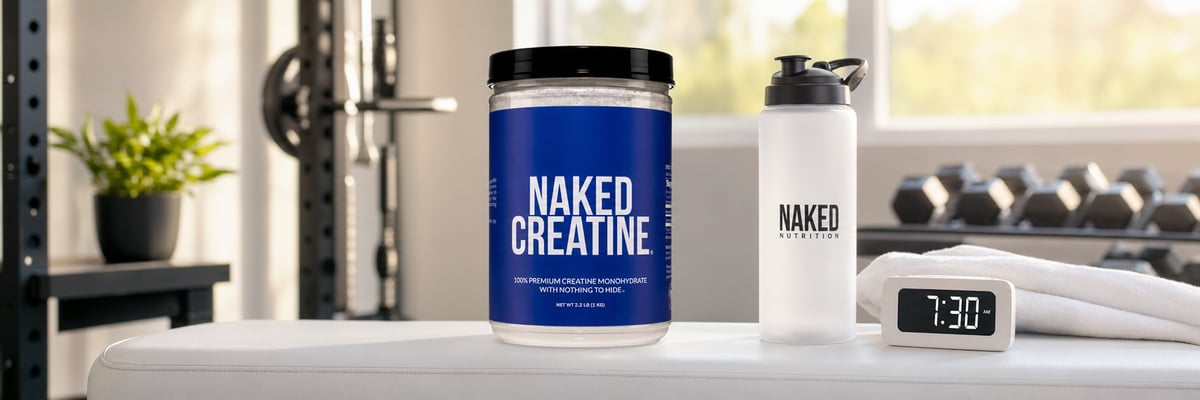
Creatine Monohydrate Powder | Naked Creatine - 2.2LB
- Free Shipping Included
- Creatine Monohydrate
- Creatine Formula
- Evidence-Based Formulas
Does Creatine Affect Sleep? Here's What the Research Says
You've probably heard that creatine builds muscle and improves performance. What you may not have heard is that it also plays a role in how your brain handles sleep deprivation. If you're asking whether creatine disrupts sleep, the short answer is no. It's not a stimulant, it contains no caffeine, and current evidence does not suggest it impairs sleep quality.
The more interesting finding is the opposite: creatine may actually help you function better after a bad night's sleep. Research indicates that creatine supplementation can reduce the cognitive and physical performance drop-off caused by sleep deprivation, making it a practical tool for anyone whose sleep isn't always ideal.
This article breaks down the mechanism behind that effect, addresses whether creatine can improve sleep quality directly, clarifies timing recommendations, and gives you a straightforward guide to choosing and using a creatine supplement.
What Is Creatine and How Does It Work?

Creatine is a naturally occurring compound synthesized in the liver and kidneys from the amino acids glycine, arginine, and methionine. It's stored primarily in skeletal muscle, but also in the brain, which is central to the sleep conversation. Your body produces about half of what it needs; the rest comes from dietary sources like red meat, poultry, and seafood.
People who follow vegetarian or vegan diets have significantly lower baseline creatine stores because they eliminate the main dietary sources. This matters because lower baseline levels mean a greater potential response to supplementation, both for muscle performance and for cognitive function.
- ATP (adenosine triphosphate) is the primary energy currency your cells use for every function, from muscle contractions to neural firing.
- During high-intensity effort, ATP is rapidly depleted. Phosphocreatine donates a phosphate group to regenerate ATP almost instantly.
- Supplementing with creatine increases the phosphocreatine pool in both muscles and the brain, extending the window of high-output energy availability.
- This same mechanism operates in neurons, which is why creatine has cognitive as well as physical benefits.
The standard maintenance dose is 3 to 5g of creatine daily. Some protocols use a loading phase of 20g per day (split into four 5g doses) for the first 5 to 7 days to saturate stores faster. As Kreider et al. (2017) note, creatine is one of the most extensively studied supplements in sports nutrition, with a well-established safety profile across a range of populations.
Can Creatine Help with Sleep Deprivation?

This is where the research gets genuinely interesting. Sleep deprivation drains brain energy. When you don't get enough sleep, phosphocreatine stores in neurons are not fully replenished, which impairs ATP synthesis and leads to reduced cognitive performance, slower reaction times, worse mood, and poor decision-making. Creatine supplementation provides an additional substrate to partially offset that energy deficit.
📊 What Research Says
A study published in the Journal of Sports Sciences found that in sleep-deprived athletes, creatine supplementation produced essentially the same improvement in athletic performance as caffeine, without caffeine's side effects. The researchers concluded that creatine's effect on brain phosphocreatine restoration was the likely driver, as detailed by Cook et al. (2011).
The brain energy mechanism works through adenosine as well. As you accumulate sleep debt, adenosine builds up in the brain, creating what's called sleep pressure. Reduced ATP availability accelerates this buildup. By maintaining higher phosphocreatine levels, creatine supplementation supports faster ATP restoration in neurons, partially counteracting the adenosine-driven cognitive decline that sleep deprivation causes.
There's a critical distinction to make here: creatine does not improve sleep quality in the way that a sleep aid does. It does not make you fall asleep faster, extend total sleep time, or alter sleep architecture directly. What it does is reduce how much your performance suffers when sleep is inadequate. That's a meaningful but specific benefit, and conflating the two sets up unrealistic expectations. Porkka-Heiskanen et al. (2006) provide useful context on the adenosine-ATP interaction and why brain energy metabolism is central to understanding sleep-related creatine effects.
Does Creatine Improve Sleep Quality Directly?

The relationship between Creatine and Water Retention and sleep quality is more nuanced than the sleep deprivation question. Slow-wave sleep, also called deep sleep, is the stage during which the brain performs most of its restoration work. Research indicates that phosphocreatine stores in the brain are actively replenished during slow-wave sleep, as noted by Dworak et al. (2017). This suggests a bidirectional relationship: adequate deep sleep supports creatine replenishment, and higher creatine availability supports the energy demands of the restorative processes that occur during that sleep stage.
What this means practically is still being studied. There isn't yet strong clinical evidence that creatine supplementation increases time spent in slow-wave sleep or improves objective sleep quality metrics in healthy adults with normal sleep patterns. The more accurate framing is that creatine supports the brain energy systems that overlap with sleep architecture, which may have downstream benefits.
The people most likely to notice a meaningful difference are those with chronically disrupted sleep patterns. That includes:
- Athletes training twice daily or during competition blocks with reduced recovery time
- Shift workers whose sleep timing is constantly irregular
- New parents managing fragmented sleep for extended periods
- Students during high-stress exam periods
- High-stress professionals whose sleep quality is consistently compromised
For people sleeping 7 to 9 hours consistently, creatine is unlikely to produce noticeable sleep-related improvements. Its value in this context is clearest when sleep is the constraint.
Can Creatine Cause Insomnia or Disrupt Sleep?

Some users report difficulty sleeping after starting creatine. The concern is worth addressing directly, but the mechanism isn't creatine itself. Creatine is not a stimulant. It contains no caffeine, has no adrenergic properties, and does not raise cortisol or heart rate. There is no pharmacological pathway through which creatine monohydrate should prevent you from falling or staying asleep.
The more likely explanation when sleep disruption occurs is context, not creatine. The most common scenario involves taking creatine as part of a pre-workout stack that also contains caffeine, beta-alanine, or other stimulants. If you're taking a stimulant-containing pre-workout close to bedtime and attributing sleep disruption to creatine, the cause-and-effect relationship is almost certainly misattributed.
📊 What Research Says
Extensive safety reviews of creatine supplementation, including a comprehensive position paper from the International Society of Sports Nutrition reviewed by Antonio et al. (2021), do not list insomnia or sleep disruption among documented side effects of creatine monohydrate at standard doses.
Water retention is a real creatine side effect, and it's worth considering in this context. Creatine draws water into muscle cells, which can cause a temporary bloating sensation, particularly during a loading phase. For some people, physical discomfort from bloating could affect sleep quality indirectly. If this is a concern, skipping the loading phase and starting with a standard 3 to 5g daily dose from the outset typically minimizes water retention significantly.
The practical recommendation is simple: if you're cautious, take creatine in the morning or around midday. Current evidence does not require this, but it removes any ambiguity and keeps your evening routine free of unnecessary variables.
Best Time to Take Creatine for Sleep and Recovery

Timing creatine for sleep-related benefits follows different logic than timing it before or after a workout . The most practical application based on current research is morning dosing after a poor night of sleep. Taking 3 to 5g of creatine in the morning on a day following inadequate sleep supports brain phosphocreatine availability during the hours when cognitive performance deficits are most pronounced.
Pairing creatine with carbohydrates improves uptake. The insulin response triggered by carbohydrate consumption increases creatine transport into both muscle and neural tissue, so taking your dose with breakfast or a morning shake that includes carbohydrates is a straightforward way to optimize absorption.
- Muscle creatine saturation, not acute timing, drives most of creatine's benefits. Consistency over weeks matters more than whether you take it at 8am versus noon.
- Morning dosing is preferred for sleep-related cognitive support, since this is when post-deprivation performance deficits are highest.
- Taking creatine at night is not harmful, but there's no established benefit for doing so specifically, and it adds stimulant-stacking risk if combined with evening pre-workouts.
- With or without food both work, but with carbohydrates improves transport efficiency.
One point worth emphasizing: no timing protocol compensates for chronically inadequate sleep. Creatine reduces the performance impact of occasional poor sleep. It does not offset the cumulative physiological damage of sleep deprivation over time. Use it as a buffer, not a replacement for actual sleep hygiene.
How to Choose and Use a Creatine Supplement
Creatine monohydrate is the form you want. It has the largest body of research behind it, it's the most cost-effective option on the market, and it performs as well as or better than every newer, more expensive creatine variant in head-to-head comparisons, as confirmed by Lanhers et al. (2017). There is no compelling reason to pay more for creatine HCl, buffered creatine, or other modified forms unless you have a specific documented intolerance to monohydrate.
When selecting a product, the ingredient list should be short. Single-ingredient creatine monohydrate powder, with no fillers, artificial sweeteners, or proprietary blends. Creatine and weight gain is a common concern, and Naked Nutrition's Creatine Monohydrate is exactly that: one ingredient, third-party tested, and available in a format that mixes cleanly into water, shakes, or smoothies without clumping.
Dosing guidelines are straightforward:
- Maintenance dose: 3 to 5g daily, taken consistently
- Loading phase (optional): 20g daily split into four 5g doses for 5 to 7 days, then drop to maintenance
- No loading: Skipping the loading phase and starting at 3 to 5g daily reaches saturation in 3 to 4 weeks instead of 1 week — effective but slower
Vegetarians and vegans tend to see more pronounced benefits from creatine supplementation because their baseline muscle and brain creatine stores are lower than those of meat eaters. If you don't consume red meat or seafood regularly, supplementation is particularly worth prioritizing.
If you're using creatine specifically for sleep deprivation support, the same standard dose applies. What is a creatine cycle? There is no established sleep-specific dosing that differs from the general maintenance recommendation, and taking more than 5g daily does not appear to provide additional cognitive benefit once stores are saturated.
Frequently Asked Questions
Does creatine affect sleep quality?
Creatine may influence sleep quality both positively and negatively depending on the individual and timing of supplementation. Some research suggests creatine supports brain energy metabolism during sleep, which could improve sleep efficiency, while others report difficulty falling asleep when taking creatine too close to bedtime.
Can creatine cause insomnia or trouble falling asleep?
Some users report difficulty falling asleep when they take creatine in the evening, possibly due to its stimulating effect on brain energy levels. To minimize this risk, it is generally recommended to take creatine earlier in the day, such as before or after your workout, rather than right before bed.
Does creatine help with sleep deprivation?
Emerging research suggests that creatine supplementation may help offset some cognitive and physical performance declines associated with sleep deprivation. Because creatine replenishes phosphocreatine stores in the brain, it may support mental clarity and reaction time even when you haven't gotten a full night's rest.
What is the best time of day to take creatine to avoid sleep disruption?
Most experts recommend taking creatine in the morning or around your workout window to reduce the likelihood of sleep disruption. Since the timing of creatine relative to overall daily stores matters less than consistent daily intake, shifting your dose earlier in the day is an easy adjustment if you notice sleep issues.
How much creatine should I take daily?
The most well-studied and widely recommended maintenance dose of creatine is 3–5 grams per day of creatine monohydrate. Some protocols begin with a loading phase of 20 grams per day split into four doses for 5–7 days, though this phase is optional and skipping it will still allow your muscles to saturate over time.
Is creatine safe to take long-term?
Creatine monohydrate is one of the most extensively researched sports supplements available and has been shown to be safe for long-term use in healthy individuals. Studies spanning several years have found no adverse effects on kidney or liver function in people without pre-existing conditions when taken at recommended doses.
Does creatine interact with sleep aids or melatonin?
There are currently no well-documented interactions between creatine and common sleep aids such as melatonin or magnesium supplements. However, if you are taking prescription sleep medications, it is always best to consult your healthcare provider before adding any new supplement to your routine.
Will creatine supplementation affect my dreams or REM sleep?
Some anecdotal reports suggest that creatine may lead to more vivid or intense dreams, though this has not been rigorously studied in controlled clinical trials. One hypothesis is that increased brain energy availability during sleep may affect the intensity of REM activity, but more research is needed to confirm this connection.
Top Product Picks
Chosen by 1 million+ customers. Free shipping on orders over $100.
Creatine Monohydrate Powder | Naked Creatine - 2.2LB
$35.99
- ✓ 100% premium creatine monohydrate
- ✓ Highest grade available: fast dissolving and quickly absorbed
- ✓ 5g of creatine per serving
- ✓ No artificial sweeteners, flavors, or colors

Strawberry Creatine Monohydrate Powder | Naked Creatine - 1.1LB
$29.99
- ✓ 100% premium creatine monohydrate
- ✓ Highest grade available: fast dissolving and quickly absorbed
- ✓ 5g of creatine per serving
- ✓ No Artificial Sweeteners, Flavors, or Colors

Orange Creatine Monohydrate Powder | Naked Creatine - 1.1LB
$29.99
- ✓ 100% premium creatine monohydrate
- ✓ Highest grade available: fast dissolving and quickly absorbed
- ✓ 5g of creatine per serving
- ✓ No artificial sweeteners, flavors, or colors