


Key Takeaways
- Different movement patterns: Hip thrusts emphasize hip extension and peak glute contraction; squats are knee-extension dominant and load the glutes through a larger range of motion.
- The research is contested: A Brazilian study found squats produced greater glute muscle thickness than hip thrusts, but respected researchers have challenged its methodology and demanded retraction.
- Goal-dependent answer: Neither exercise universally wins. Your anatomy, training experience, mobility, and whether you can actually feel your glutes during squats all determine which is better for you.
- Combining both is likely optimal: Use hip thrusts for glute isolation and activation, squats for overall lower body strength and muscle development.
- Nutrition closes the gap: Adequate protein and creatine monohydrate directly support the muscle repair and strength gains that either exercise demands.

Creatine Monohydrate Powder | Naked Creatine - 1.1LB
- 100% premium creatine monohydrate
- Highest grade available: fast dissolving and quickly absorbed
- 5g of creatine per serving
- No artificial sweeteners, flavors, or colors
Hip Thrusts vs Squats: Which Exercise Actually Builds Better Glutes?

Your glutes are the largest muscle group in your body. Training them well makes you a stronger athlete, reduces lower back pain, corrects posture, and prevents the kind of muscle imbalances that sideline lifters for weeks. And yes, well-developed glutes look good too. No apologies for stating the obvious.
The debate over hip thrusts vs squats for glute development is one of the most argued topics in strength training. Both exercises appear in nearly every lower body program. Both coaches and researchers have strong opinions. And the actual answer, backed by the best available evidence, is more nuanced than either side tends to admit.
This article covers the muscle mechanics behind each exercise, what the research actually found and why it's contested, which exercise fits your specific goals and body, how to perform both correctly, and how to program them together for maximum glute development.
What Muscles Do Hip Thrusts and Squats Work?

A back squat is a bilateral, knee-extension-dominant compound movement. You load a barbell across your upper back, descend until your thighs are roughly parallel to the floor, and drive back up. The primary movers are the quadriceps, with meaningful contributions from the gluteus maximus, hamstrings, and spinal erectors. The core works hard throughout to maintain trunk rigidity.
A barbell hip thrust is a hip-extension-dominant movement. You rest your upper back on a bench, place a barbell across your hips, and drive your hips toward the ceiling by squeezing your glutes. The gluteus maximus is the primary mover. Hamstrings assist, but quad involvement is minimal. The key mechanical advantage of the hip thrust is that the glutes are under peak tension at full hip extension, the exact position where they produce the most force.
- Squats load the glutes most at the bottom of the movement (hip flexion), where the muscle is lengthened but tension is shared with the quads.
- Hip thrusts load the glutes at the top of the movement (full hip extension), where the gluteus maximus is at its strongest and most isolated.
- Neither position is inherently superior, but they stress the glute differently, which is exactly why combining both exercises makes mechanical sense.
| Exercise | Primary Muscles | Secondary Muscles | Movement Pattern |
|---|---|---|---|
| Back Squat | Quadriceps, Gluteus Maximus | Hamstrings, Core, Spinal Erectors | Knee Extension Dominant |
| Barbell Hip Thrust | Gluteus Maximus | Hamstrings, Core | Hip Extension Dominant |
What Does the Research Say About Hip Thrusts vs Squats?

A Brazilian study set out to directly compare the two exercises in trained women. Twenty-two experienced female lifters were divided into two groups: 12 performed back squats for 12 weeks, and 10 performed hip thrusts. Researchers measured quad and glute muscle thickness via ultrasound and tested one-rep max on both exercises before and after the intervention.
The results favored squats. Both groups gained muscle thickness and strength, but the squat group showed significantly greater increases in both quadriceps and gluteus maximus thickness. Strength gains measured by one-rep max were comparable between groups, which suggests hip thrusts are at least as effective for building exercise-specific strength.
📊 What Research Says
The Brazilian study found that after 12 weeks, the back squat group produced significantly greater gains in gluteus maximus muscle thickness than the hip thrust group, but a white paper from respected strength and conditioning researchers has since challenged the study's methodology, citing improbable strength gains and participant data inconsistencies, and formally called for its retraction.
That controversy matters. The white paper authors argue that the participants' baseline characteristics were suspiciously uniform, and that the reported strength improvements were inconsistent with outcomes seen in comparable research. This doesn't mean the squat group didn't outperform the hip thrust group, but it does mean interpreting these results as definitive would be premature.
Separate EMG research consistently shows that hip thrusts produce high levels of gluteus maximus activation, often exceeding squats in peak muscle firing. The science on hip thrusts vs squats is not settled. Both exercises have genuine merit, and a single contested study isn't enough to dismiss either.
Hip Thrusts vs Squats: Which Is Better for Your Goals?

The answer is goal-dependent and body-dependent. Your anatomy, training history, and what you actually feel during each exercise all influence which will deliver better results for your glutes specifically.
- Maximum overall lower body strength and muscle: Back squats are hard to beat. They load the entire lower body through a large range of motion, drive significant mechanical tension through the glutes, and build the quad strength that transfers to athletic performance and daily function.
- You can't feel your glutes during squats: This is a quad dominance issue. If your quads are always taking the lead, the glutes aren't getting the stimulus they need. Hip thrusts are a better starting point because they isolate the hip extension pattern and force the glutes to work without quad compensation.
- Mobility limitations or lower back sensitivity: Deep squatting requires significant ankle dorsiflexion, hip mobility, and thoracic extension. Hip thrusts are more accessible for people working around these restrictions. The movement is less technically demanding and puts far less compressive load on the lumbar spine.
- Maximum glute isolation and peak contraction: Hip thrusts win here. The fully extended top position of the hip thrust is where the gluteus maximus produces peak force, and that sensation of a hard contraction at lockout is a reliable indicator of effective muscle recruitment.
Anatomy also plays a role that often goes unacknowledged. Hip socket depth and femur length significantly affect how much glute engagement you get from a squat. Lifters with longer femurs or deeper hip sockets often find it harder to bias the glutes in a squat and may respond better to hip thrusts by default.
How to Perform Hip Thrusts and Back Squats with Proper Form
Technique determines whether these exercises build your glutes or just load your joints. Here's what matters most for each.
Back Squat form cues:
- Place the bar across your upper traps (high bar) or rear deltoids (low bar). Both are valid, but low bar shifts more load to the posterior chain.
- Set your feet shoulder-width apart or slightly wider, toes turned out 15 to 30 degrees.
- Brace your core hard before you unrack. Take a deep breath into your belly, create intra-abdominal pressure, and hold it through the descent and ascent.
- Descend with control, keeping your chest up and knees tracking over your toes. Aim for at least parallel depth, with hips below the knee crease.
- Drive through the full foot on the way up, squeeze the glutes at lockout. The Mind Pump TV back squat tutorial is an excellent visual reference for these cues.
Barbell Hip Thrust form cues:
- Sit with your upper back against a bench that hits just below your shoulder blades. Use a bar pad to protect your hips.
- Plant your feet flat, hip-width apart, shins vertical when hips are at the top. If your shins angle forward too much, move your feet further away.
- Drive through your heels, extend the hips fully, and squeeze the glutes hard at the top. Your chin should stay tucked, not tilted back.
- Lower under control, don't let the plates crash to the floor. Bret Contreras PhD , the creator of the barbell hip thrust, provides a detailed tutorial worth following before you load up.
Common mistakes to avoid: hyperextending the lower back at the top of the hip thrust, squatting with a caved knee position, using a bench that's too tall for hip thrusts, and cutting squat depth short to avoid discomfort. For glute activation before squats, single-leg bodyweight hip thrusts work well and carry minimal fatigue cost.
Should You Do Both Hip Thrusts and Squats? How to Program Them Together

For most people, choosing between hip thrusts and squats is a false binary. The exercises complement each other. Squats train the glutes through hip flexion under load. Hip thrusts train peak hip extension. Together, they cover the full strength curve of the gluteus maximus in a way neither exercise does alone.
A practical lower body session structure looks like this:
- Glute activation warm-up: 2 sets of 10 bodyweight single-leg hip thrusts. The goal here is neural activation, not fatigue. Keep it light and deliberate.
- Primary strength work: Back squats, 3 to 4 sets of 4 to 6 reps at heavier loads if strength is the priority, or 3 sets of 8 to 10 reps for hypertrophy.
- Accessory hypertrophy work: Barbell hip thrusts, 3 to 4 sets of 8 to 12 reps. This is where you focus on the glute contraction quality and progressive overload.
Programming note: If you're doing heavy barbell hip thrusts as a primary exercise before squats, expect your squat performance to suffer. Fatigue from loaded hip thrusts is real. Keep warm-up activation sets light, and save heavy hip thrust work for after your main squat sets.
Progressive overload applies to both exercises. Add weight, add reps, or reduce rest periods over time. Glute development responds to volume and consistency, not just exercise selection. Tracking your working weights over weeks is non-negotiable if you want to see measurable progress.
Support Your Glute Gains with the Right Nutrition

Training creates the stimulus. Nutrition determines what your body does with it. If your protein intake and total calorie intake aren't dialed in, the best exercise selection in the world won't produce the glute growth you're after.
Muscle growth requires a slight caloric surplus and consistent protein intake. The current evidence-based recommendation for muscle building is 0.7 to 1 gram of protein per pound of bodyweight per day. For most active people, hitting that target from whole food alone is a challenge, which is where protein supplementation earns its place.
Naked Whey is a grass-fed whey protein concentrate with one ingredient. Each serving delivers 25 grams of protein with a high leucine content, the amino acid most responsible for triggering muscle protein synthesis. Grass-fed sourcing also means a better fatty acid profile compared to conventional whey. Take it post-training when muscle protein synthesis is elevated and your muscles are primed to absorb nutrients.
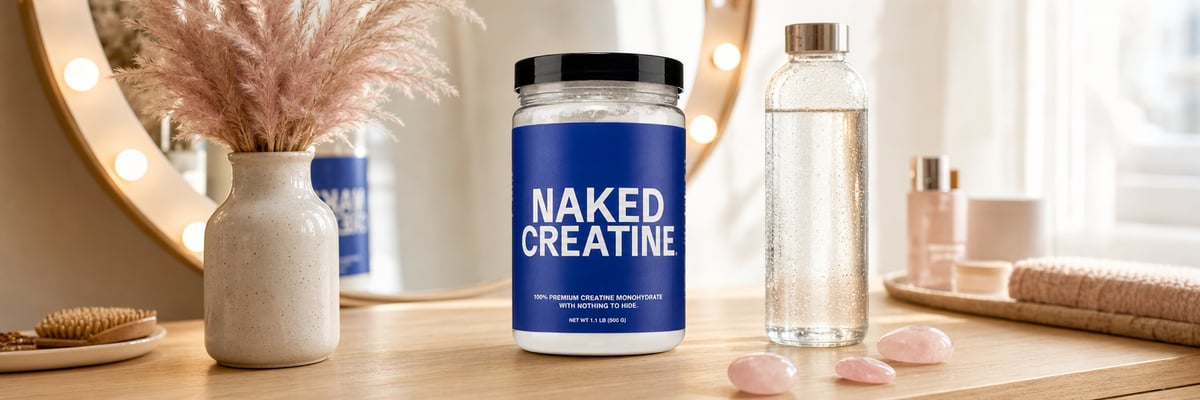
Naked Creatine is 100% creatine monohydrate with nothing added. Creatine replenishes phosphocreatine stores in muscle tissue, which means you can sustain power output through those final two or three reps that drive adaptation. It also shortens recovery between sets, allowing for more total training volume per session. Five grams per day is the standard dose, and the evidence supporting it spans decades of research. Check out the guides on when to take creatine, how much creatine is too much, and the facts on creatine and water retention.
Get your training consistent, eat enough protein, stay in a slight caloric surplus, and add creatine. These four actions drive more glute development than debating hip thrusts vs squats ever will.
Frequently Asked Questions
Which exercise builds bigger glutes faster: hip thrusts or squats?
Hip thrusts produce greater glute activation at peak contraction, making them the more direct stimulus for glute hypertrophy. Research by Contreras et al. (2015) in the Journal of Strength and Conditioning Research confirmed significantly higher EMG activity in the glutes during hip thrusts compared to back squats. That said, squats build the surrounding muscle groups that support glute development, so using both together gets you further than either alone.
Can beginners do hip thrusts, or should they start with squats first?
Beginners can start with both, but bodyweight squats are often easier to learn because the movement pattern is more intuitive. Hip thrusts require some hip hinge awareness and core stability to perform safely under load, so it's worth mastering the bodyweight version before adding a barbell. Starting with both movements at low intensity builds the foundation you need to progress effectively in either direction.
Do hip thrusts put less stress on the knees than squats?
Yes. Hip thrusts are a hip-dominant movement, so the knee joint handles minimal load compared to squats. Squats place meaningful stress on the patellar tendon and knee ligaments, particularly at depth, which can be an issue if you're managing a knee injury or chronic knee pain. Hip thrusts are frequently used in rehabilitation settings for this exact reason.
Are squats better than hip thrusts for overall leg development?
Squats win for overall lower body development because they recruit the quadriceps, hamstrings, glutes, and calves simultaneously across a large range of motion. Hip thrusts are more targeted, focusing on the glutes and to a lesser extent the hamstrings. If your goal is complete leg development rather than isolated glute growth, squats carry more of the load.
Should I do hip thrusts and squats in the same workout?
You can, and many well-designed programs do program them together. The key is sequencing: squats typically come first because they demand more from your central nervous system and require greater coordination under heavy load. Hip thrusts work well as a follow-up finisher to maximally fatigue the glutes after your compound work is done.
How much weight should I be using for hip thrusts compared to squats?
Most people can hip thrust significantly more weight than they squat because the range of motion is shorter and the loading position is mechanically advantageous for the glutes. It's not uncommon to hip thrust 20 to 40 percent more than your back squat once you've built proficiency with the movement. Use load relative to your own technique, not someone else's numbers.
Do hip thrusts or squats burn more calories?
Squats burn more calories per session because they recruit more total muscle mass and place greater demand on your cardiovascular and metabolic systems. Hip thrusts are a more isolated exercise, so caloric expenditure is comparatively lower. If fat loss is a primary goal, squats contribute more to overall energy output, but neither exercise should be your only tool for managing body composition.
Can nutrition support hip thrust and squat performance and recovery?
Absolutely. Protein intake directly supports the muscle repair and growth triggered by both exercises, with research consistently showing that 1.6 to 2.2 grams of protein per kilogram of bodyweight per day optimizes muscle protein synthesis (Morton et al., 2018, British Journal of Sports Medicine). Carbohydrates fuel the glycolytic demands of heavy compound lifting, so don't neglect them around training. Clean, minimal-ingredient protein supplements can help you hit your targets when whole food sources fall short.
Top General Nutrition Picks
Chosen by 1 million+ customers. Free shipping on orders over $100.

Pea Protein Powder | Naked Pea - 5LB
$57.99
- ✓ Sustainable Farming Practices
- ✓ Superior Amino Acid Profile
- ✓ Promote Muscle Gain
- ✓ Lose Weight

Grass Fed Whey Protein Powder | Naked Whey - 5LB
$139.99
- ✓ Build and Maintain Lean Muscle Mass
- ✓ Boost Immune System
- ✓ Lose Fat
- ✓ Improve Heart Health

Branched Chain Amino Acids | Naked BCAAs - 100 Servings
$34.99
- ✓ Pharmaceutical-grade Branch Chain Amino Acids
- ✓ Dissolves and mixes easily
- ✓ Quick absorption formula
- ✓ 2:1:1 ratio of Leucine, Isoleucine, and Valine