




On this page
Is Creatine Vegan? What Plant-Based Athletes Need to Know
Discover whether creatine fits a vegan lifestyle and how plant-based athletes can safely boost their performance with this popular supplement.

Key Takeaways
- Creatine supplements are vegan: Commercial creatine monohydrate is synthesized from non-animal compounds, making it fully vegan-friendly.
- Food-based creatine is not vegan: Dietary creatine comes exclusively from meat, fish, poultry, and eggs — plant foods contain none.
- Vegans may benefit most: Starting from lower baseline stores, vegans typically see greater increases in muscle creatine levels after supplementation compared to omnivores.
- Watch out for capsule formats: Many creatine capsules use bovine gelatin. Choose powder or verified vegan capsules.
- Look for the Certified Vegan logo: This ensures the product contains no animal ingredients and was not tested on animals.
- Standard dose is 3 to 5g per day: Loading is optional. Consistent daily use reaches full muscle saturation in 3 to 4 weeks.

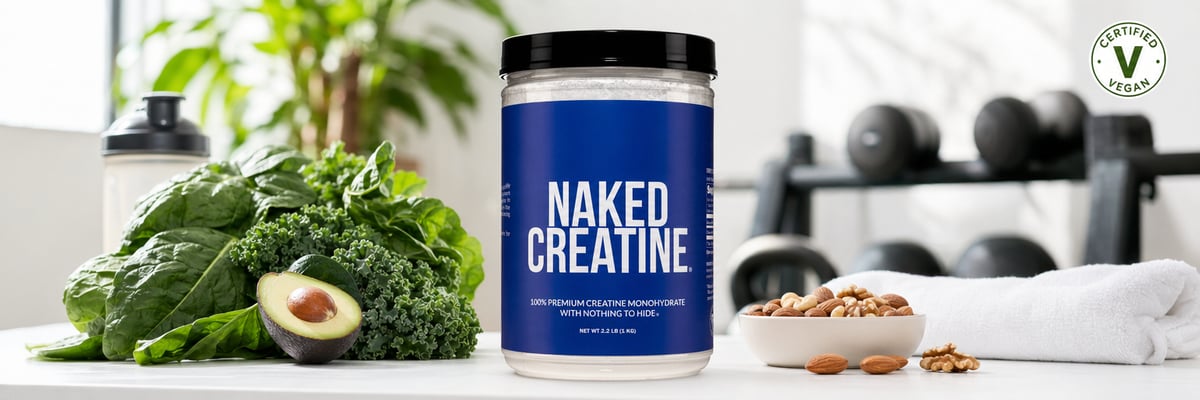
Creatine Monohydrate Powder | Naked Creatine - 2.2LB
- Free Shipping Included
- Creatine Monohydrate
- Creatine Formula
- Evidence-Based Formulas
Is Creatine Vegan? The Short Answer

Yes. Most creatine supplements are completely vegan-friendly. The creatine powder you find on a supplement shelf is not extracted from animals — it's synthesized in a lab from non-animal chemical precursors. No meat, no bone, no animal byproducts.
The confusion comes from a legitimate distinction worth understanding. Creatine as a naturally occurring compound is found almost exclusively in animal muscle tissue. Red meat, poultry, and fish are the primary dietary sources. If you eat those foods, you're getting creatine. If you don't, you're not getting any meaningful amount from food.
But creatine as a supplement is a different story entirely. Commercial creatine monohydrate is manufactured through a purely synthetic process that involves no animal inputs at any stage. The end product is chemically identical to the creatine your muscles use, and it's produced without harming or using any animal.
There is one exception to flag immediately: creatine in standard capsule form. Many capsule shells are made from bovine gelatin, which is not vegan. The creatine inside may be vegan, but the shell is not. Powder format solves this problem directly.
The rest of this article covers how creatine works, why vegans stand to benefit more than most people from supplementing it, what to look for when choosing a product, and how to dose it effectively.
What Is Creatine and How Does It Work?

Creatine is a naturally occurring compound synthesized in the body from three amino acids: arginine, glycine, and methionine. It's stored primarily in skeletal muscle, with smaller amounts in the brain and testes, as noted by Wyss and Kaddurah-Daouk (2000) [1]. Your liver, kidneys, and pancreas collectively produce roughly 1 gram of creatine per day, as documented by Kreider et al. (2017) [2]. The rest, under normal circumstances, comes from food.
Inside muscle tissue, creatine is stored as phosphocreatine. During high-intensity exercise — sprinting, heavy lifting, explosive movements — your muscles burn through adenosine triphosphate (ATP) at a rate that your aerobic energy system can't match. Phosphocreatine steps in to rapidly regenerate ATP, extending the duration and power output of those efforts. Antonio et al. (2021) [3] confirm that increasing phosphocreatine stores improves exercise capacity, performance, muscle growth, and recovery.
The key limiting factor is how full those phosphocreatine stores are to begin with. This is where diet plays a significant role. Dietary creatine comes exclusively from animal-derived foods: red meat, poultry, fish, and seafood. Plant foods contain no creatine.
- Your body stores creatine in muscle tissue as phosphocreatine
- During intense exercise, phosphocreatine rapidly donates a phosphate group to regenerate ATP — your primary energy currency
- Fuller phosphocreatine stores mean more fuel available during high-effort sets or sprints
- The body produces ~1g of creatine daily on its own; dietary intake tops up the rest
- Vegans receive zero creatine from food, leaving their stores dependent entirely on endogenous production
For vegans, this means endogenous production of 1 gram per day is the only source. That's enough to maintain basic function, but it leaves muscle creatine stores measurably below what omnivores typically carry. Supplementation directly addresses that gap.
How Is Creatine Supplement Made? (And Why It's Vegan)

Creatine monohydrate, the most researched and widely used form, is manufactured through a fully synthetic chemical process. The two primary precursors are sodium sarcosine (a derivative of the amino acid glycine) and cyanamide (an inorganic nitrogen compound). Neither is sourced from animals. As established in the manufacturing patents reviewed by Persky and Brazeau (2001) [4] and US Patent 5,719,319 [5], these compounds are combined under heat in a controlled reactor environment.
Once the reaction is complete, the mixture is cooled and put through a purification process using centrifugation. The resulting material is dried and milled into a fine white powder — the creatine monohydrate you find in supplements. No animal products are used at any point in this process, as confirmed by US Patent 6,326,513 [6].
Other creatine forms — creatine HCL, buffered creatine, creatine ethyl ester — are produced through similarly synthetic routes and are generally vegan by the same logic. The active ingredient in all of them is animal-free.
📊 What Research Says
The commercial synthesis of creatine monohydrate from sodium sarcosine and cyanamide — both non-animal compounds — has been the industry standard for decades. Per Persky and Brazeau (2001) [4], this process yields a pure creatine product chemically identical to what the human body produces, with no animal inputs at any stage of manufacturing.
The one genuine exception is delivery format. Standard capsule shells are made from bovine gelatin, which is derived from animal collagen. The creatine inside is vegan; the capsule is not. If you're vegan, choose powder format or look specifically for vegan capsule products, which use plant-derived cellulose shells instead.
Why Vegans May Benefit Most from Creatine Supplementation

Creatine benefits virtually everyone who uses it consistently. But the research suggests vegans and vegetarians have the most to gain. The reason comes down to baseline stores.
Because plant foods contain no creatine, vegans rely entirely on endogenous synthesis to maintain muscle creatine levels. That 1 gram per day produced internally is enough to sustain normal metabolic function, but it leaves muscle phosphocreatine stores measurably lower than those of people who also eat meat. Kreider et al. (2017) [2] confirm that vegetarians and vegans typically have lower resting muscle creatine concentrations compared to omnivores.
Lower starting stores mean more room to fill. And when you have more room to fill, supplementation produces a larger relative response. Studies have shown that vegetarians experience greater increases in muscle phosphocreatine concentration following creatine supplementation than their omnivore counterparts. More creatine stored in the muscle translates directly to better performance gains, greater strength increases, and more pronounced improvements in muscle mass.
The cognitive angle is also worth noting. The brain maintains its own creatine stores, and those stores follow the same pattern: lower in people who consume no dietary creatine. Creatine plays a role in brain energy metabolism, and emerging research points to supplementation supporting cognitive function — memory, processing speed, and mental fatigue resistance. For vegans who may also be managing lower intake of other brain-supporting nutrients like B12 and omega-3s, this adds an additional reason to consider creatine beyond the gym.
Put plainly: creatine is one of the highest-return supplements a vegan athlete can take. The baseline deficit creates the opportunity, and supplementation fills it efficiently.
Health Benefits of Creatine for Vegan Athletes

Creatine's benefits are well-documented across hundreds of studies, and they extend across multiple systems in the body. For vegan athletes, here's what the evidence supports:
- Improved high-intensity performance: More phosphocreatine available means more ATP regenerated during explosive or heavy efforts. You can train harder, lift more, and sustain output longer before fatigue sets in. Antonio et al. (2021) [3] confirm this across strength and power-based training contexts.
- Increased muscle mass: The performance gains compound over time into greater muscle development. Creatine also stimulates insulin-like growth factor-1 (IGF-1), a hormone that directly promotes muscle protein synthesis, as shown by Burke et al. (2008) [8].
- Faster recovery: Creatine supplementation is associated with reduced muscle cell damage and inflammation following intense training, shortening the time needed between sessions.
- Cell volumization: Creatine draws water into muscle cells, increasing intracellular volume and contributing to a fuller, denser muscle appearance. This is intracellular hydration — not subcutaneous bloating. Rawson and Volek (2003) [9] note this effect is present during active supplementation and reverses when supplementation stops.
- Brain health support: Research suggests creatine may support cognitive function and offer neuroprotective effects relevant to conditions like Parkinson's disease and Alzheimer's, per Beal (1999) [10] and Wyss and Schulze (2002) [11]. Human trial evidence is still developing, but the mechanistic basis is sound.
Creatine monohydrate is among the most studied compounds in sports nutrition. It is considered safe for healthy adults across long-term use, with no credible evidence of harm to kidney or liver function in people without pre-existing conditions.
How to Choose a Vegan Creatine Supplement
Not all creatine products are equal from a vegan standpoint. Here's what to look for and what to avoid.
- Look for the Certified Vegan logo: Issued by Vegan.org, this certification confirms the product is free of all animal-derived ingredients and was not tested on animals, as outlined by Vegan.org's certification standards [7]. It's the clearest single signal you can use at the label level.
- Choose powder or vegan capsule formats: Standard capsules use bovine gelatin. Powder is the simplest solution. If you prefer capsules, confirm the shell is made from cellulose (plant-derived), not gelatin.
- Stick to pure creatine monohydrate: The fewer ingredients, the better. Many pre-workout blends contain creatine, but they also contain sweeteners, artificial flavors, stimulants, and other additives that may not align with your dietary standards or training needs.
- Look for third-party testing: Certifications from NSF Certified for Sport or Informed Sport verify that a product has been independently tested for label accuracy and the absence of banned substances. This matters for competitive athletes and anyone who wants confidence in what they're actually consuming.
📊 What Research Says
Creatine monohydrate remains the most research-backed form available. Per Antonio et al. (2021) [3], no other creatine form has been shown to outperform it for muscle saturation, performance, or safety. Single-ingredient monohydrate powder is the rational default.
Naked Creatine is a single-ingredient creatine monohydrate powder that carries the Certified Vegan logo, contains no additives or fillers, and is manufactured with full ingredient transparency. For vegans who want the simplest, cleanest option available, it covers every criterion above without compromise.
How Much Creatine Should Vegans Take?

The standard maintenance dose of creatine is 3-5 grams per day . Taken consistently, this is enough to progressively saturate muscle phosphocreatine stores over 3 to 4 weeks. For most people, this approach is simpler, more comfortable, and equally effective long-term.
Some people choose to use a loading phase to reach full saturation faster. This involves taking 20 to 25 grams per day, split into 4 to 5 doses of approximately 5 grams each, for 5 to 7 days. After loading, you drop to a standard maintenance dose of 3 to 5 grams daily. Lanhers et al. (2017) [14] confirm this protocol achieves full muscle saturation significantly faster than the no-load approach.
Loading is optional. The trade-off is that high daily doses can cause GI discomfort in some people — bloating, cramping, or loose stools. Splitting doses throughout the day reduces this risk, but it doesn't eliminate it entirely. If your digestive system is sensitive, skip loading and use the daily dose approach instead.
Regarding timing: creatine can be taken at any point in the day. Post-workout consumption alongside carbohydrates may marginally enhance uptake by leveraging insulin-mediated transport into muscle cells, but the difference is modest. Consistency matters far more than timing precision.
For vegans specifically: because you're starting from a lower baseline than most omnivores, committing to daily supplementation without gaps is especially worth prioritizing. There's no benefit to cycling on and off — creatine works by maintaining elevated muscle stores, and interruptions undo that.

Your search ends here.
Get 15% off your first order.
No spam. Unsubscribe anytime. You'll get a confirmation email first; confirm to receive your code.
Frequently Asked Questions
Is creatine vegan?
Most creatine supplements on the market today are vegan-friendly because they are synthetically produced in a laboratory from two compounds — sarcosine and cyanamide — rather than being derived from animal sources. However, it's always important to check the label and look for products that are certified vegan, as some formulations may include non-vegan additives or fillers. Naked Nutrition's Creatine Monohydrate, for example, is 100% vegan and contains no animal-derived ingredients.
Where does creatine naturally come from?
In nature, creatine is found almost exclusively in animal-based foods such as red meat, poultry, and fish, which is why vegans and vegetarians tend to have lower baseline creatine levels than omnivores. The human body also produces small amounts of creatine naturally in the liver, kidneys, and pancreas using the amino acids glycine, arginine, and methionine. Because dietary creatine intake is minimal or nonexistent on a plant-based diet, supplementation can be especially beneficial for vegans.
How is synthetic creatine made, and why is it considered vegan?
Synthetic creatine monohydrate is manufactured through a chemical process that combines sarcosine and cyanamide under controlled heat and pressure conditions — no animals or animal byproducts are involved at any stage. The resulting creatine is molecularly identical to the creatine found in meat, meaning the body processes it exactly the same way. This makes lab-synthesized creatine a clean, ethical choice for those following a vegan lifestyle.
Do vegans actually need to supplement with creatine?
While creatine supplementation isn't strictly required for vegans, research consistently shows that plant-based eaters have lower muscle creatine stores compared to meat-eaters, which can affect athletic performance and cognitive function. Studies have found that vegans who supplement with creatine experience greater performance improvements than their omnivore counterparts, likely due to a larger "loading effect" from their lower baseline levels. For active vegans in particular, adding a creatine supplement can meaningfully close the gap caused by dietary absence.
What are the benefits of creatine for vegan athletes?
Creatine supplementation supports increased production of adenosine triphosphate (ATP), the primary energy currency used during high-intensity, short-duration exercise like weightlifting and sprinting. For vegan athletes who start with lower muscle creatine saturation, supplementation can lead to notable improvements in strength, power output, muscle recovery, and even cognitive performance. These benefits are well-supported by decades of scientific research, making creatine one of the most evidence-backed supplements available.
How much creatine should a vegan take per day?
The most commonly recommended maintenance dose of creatine is 3–5 grams per day, which is sufficient to saturate muscle creatine stores over time with consistent use. Some people choose to do a "loading phase" of 20 grams per day (split into four doses) for the first 5–7 days to reach saturation faster, though this step is optional and not necessary for long-term results. Because vegans start with lower baseline levels, they may respond especially well to both loading and maintenance protocols.
Is creatine supplementation safe for vegans?
Creatine monohydrate is one of the most extensively studied dietary supplements in the world and has a well-established safety profile for healthy individuals, including vegans. It does not interact negatively with plant-based diets and requires no special dietary adjustments to use effectively. As with any supplement, those with pre-existing kidney conditions should consult a healthcare provider before starting creatine, since the kidneys play a role in creatine metabolism.
What should vegans look for when choosing a creatine supplement?
Vegans should look for creatine products that are explicitly labeled as vegan-certified and ideally third-party tested to verify both purity and the absence of animal-derived ingredients or cross-contamination. It's also worth checking for unnecessary additives like gelatin capsules, dairy-based fillers, or artificial dyes that could compromise the product's vegan status. Choosing a simple, single-ingredient creatine monohydrate powder — like Naked Creatine — is often the cleanest and most transparent option available.
Top Product Picks
Chosen by 1 million+ customers. Free shipping on orders over $100.
Creatine Monohydrate Powder | Naked Creatine - 2.2LB
$35.99
- ✓ 100% premium creatine monohydrate
- ✓ Highest grade available: fast dissolving and quickly absorbed
- ✓ 5g of creatine per serving
- ✓ No artificial sweeteners, flavors, or colors

Strawberry Creatine Monohydrate Powder | Naked Creatine - 1.1LB
$29.99
- ✓ 100% premium creatine monohydrate
- ✓ Highest grade available: fast dissolving and quickly absorbed
- ✓ 5g of creatine per serving
- ✓ No Artificial Sweeteners, Flavors, or Colors

Lemon Lime Creatine Monohydrate Powder | Naked Creatine - 1.1LB
$29.99
- ✓ 100% premium creatine monohydrate
- ✓ Highest grade available: fast dissolving and quickly absorbed
- ✓ 5g of creatine per serving
- ✓ No artificial sweeteners, flavors, or colors