




Key Takeaways
- Standard dose: 3–5 grams of creatine monohydrate per day is the evidence-backed maintenance dose for most people.
- Loading phase: 20–25 grams per day (split into 4–5 servings) for 5–7 days saturates muscle stores faster, but it's not required.
- Higher body weight: Individuals with greater body mass may benefit from up to 10 grams per day.
- Best form: Creatine monohydrate is the gold standard with decades of research behind it; HCL is a solid alternative for those with GI sensitivity.
- Timing: Pre- or post-workout on training days; timing matters less on rest days.
- Safety: Creatine is one of the most studied supplements available and is safe for healthy adults at recommended doses.

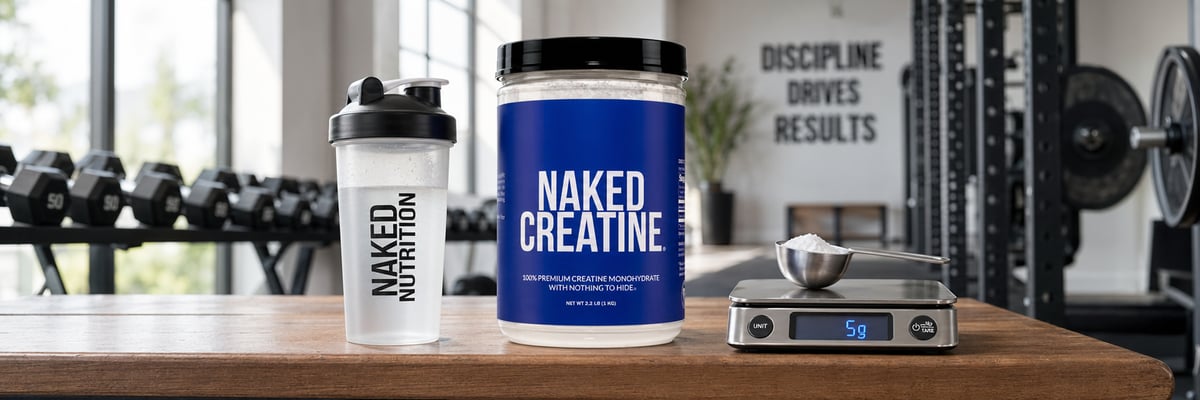
Creatine Monohydrate Powder | Naked Creatine - 2.2LB
- Creatine Monohydrate
- Creatine Formula
- Third-Party Tested
- No Artificial Additives
How Much Creatine Should You Take? Quick Answer

The answer is straightforward. For most people, 3–5 grams of creatine monohydrate per day is enough to maximize muscle creatine stores and support athletic performance. That figure comes directly from the International Society of Sports Nutrition (ISSN), which reviewed the full body of evidence on creatine dosing and safety.
Quick Reference: Creatine Dosage by Goal
- Maintenance dose (most people): 3–5g per day
- Body-weight-based dosing: 0.03g per kilogram of body weight per day
- Higher body mass (200+ lbs): Up to 10g per day
- Loading phase: 20–25g per day, split into 4–5 servings, for 5–7 days
Where people get confused is deciding between loading and skipping straight to maintenance, choosing between creatine monohydrate and HCL, and figuring out when to take it. This article covers all of that. By the end, you'll have a clear, practical protocol built around your specific goals.
What Is Creatine and How Does It Work?

Creatine is a naturally occurring compound synthesized in the liver and kidneys from three amino acids: arginine, glycine, and methionine. Your body produces roughly 1–2 grams per day on its own, and you get additional creatine from dietary sources like red meat and fish. The problem is that dietary intake typically falls short of what's needed to fully saturate muscle creatine stores, especially if you're training hard.
- ATP (adenosine triphosphate) is the immediate fuel for muscle contractions, but stored ATP lasts only a few seconds during high-intensity effort.
- When ATP is depleted, phosphocreatine donates a phosphate group to ADP, rapidly regenerating ATP and extending your capacity for explosive output.
- Supplementing with creatine increases phosphocreatine stores in muscle by up to 40%, meaning more ATP is available before fatigue sets in.
- This mechanism is most relevant for short-duration, high-intensity activities: resistance training, sprinting, and jumping.
This is why muscle cells with higher phosphocreatine reserves can sustain peak-force contractions longer before output drops. Vegans and vegetarians have significantly lower baseline muscle creatine stores because they consume no dietary creatine. Research consistently shows they experience larger performance gains from supplementation than omnivores starting from a higher baseline.
Creatine Dosage Guide: How Much to Take Based on Your Goals

A single number doesn't serve everyone equally. Body weight, training volume, and dietary habits all influence how much creatine you actually need. Here's how to think about it.
The standard 3–5 grams per day works well for most people. A more precise calculation is 0.03 grams per kilogram of body weight. For a 175-pound (80 kg) individual, that comes out to about 2.4 grams — meaning the standard 3–5g range already provides a buffer above minimum effective dosing for most body weights. For individuals over 200 pounds or with significant muscle mass, studies examining doses of 4–20 grams for up to five years found no negative health effects, supporting the case for up to 10 grams daily in heavier individuals.
Specific population guidance:
- Beginners: Start with the 3–5g maintenance dose. No need to load. You'll reach full saturation in about 28 days.
- Competitive athletes: Consider a loading phase to saturate stores in 7–10 days before a competition block.
- Older adults: 3–5g daily supports muscle preservation and may offer cognitive benefits alongside resistance training.
- Women: The same dosing guidelines apply. Body-weight-adjusted dosing may result in a slightly lower absolute dose.
If you miss a dose, continue your normal schedule the next day. There's no need to double up. Creatine works through sustained saturation of muscle stores, not acute spikes.
Creatine Loading Phase vs. Maintenance Phase: Which Is Right for You?

The loading phase exists for one reason: speed. Taking 20–25 grams per day for 5–7 days, divided into four or five 5-gram servings, can increase muscle creatine stores by 10–40% within a week. Once you've loaded, you drop down to a 3–5g maintenance dose to hold those elevated levels.
Skipping the loading phase and going straight to 3–5 grams per day also works. Research shows that this approach reaches the same end-state of full muscle saturation — it just takes approximately 28 days instead of 7–10. Same destination, slower road.
📊 What Research Says
A review published in the Journal of the International Society of Sports Nutrition confirmed that a loading protocol of 20–25g/day for 5–7 days increases intramuscular creatine stores by 10–40%, with maintenance at 3–5g/day sustaining those elevated levels long-term.
Who should load: competitive athletes who need performance gains within a week, or anyone starting a new training block who wants to feel the effects quickly. Who can skip it: general fitness enthusiasts, beginners, or anyone who finds the high-dose phase hard on their digestion.
GI discomfort is the most common complaint during loading. The fix is simple: spread your doses across meals rather than taking them all at once, and always take creatine with food and water. If discomfort persists, drop to the maintenance dose and let saturation build gradually.
Benefits of Creatine Supplementation

Creatine's benefits are unusually well-supported for a sports supplement. The research base spans decades, multiple populations, and a wide range of outcomes.
Strength and power output. A meta-analysis of 22 randomized controlled trials found that creatine significantly increased maximal strength and power versus placebo. A separate review quantified those gains: an average 8% increase in maximal strength and a 14% increase in power output. Both improvements stem from the expanded phosphocreatine pool and faster ATP regeneration during high-intensity work.
Muscle mass and body composition. Creatine pulls water into muscle cells, creating an osmotic effect that acts as a mechanical stimulus for muscle growth. Beyond hydration, creatine supplementation has been shown to increase muscle protein synthesis and reduce protein breakdown. The net result, when combined with resistance training, is measurable increases in lean body mass over time. Research confirms this effect across both younger and older trained populations.
Recovery. Creatine reduces exercise-induced muscle damage. In one study, creatine users showed lower levels of muscle damage and inflammatory markers post-exercise. A review of professional soccer players found reduced damage and inflammation markers after competition. The proposed mechanisms include creatine's antioxidant properties and its role in supporting mitochondrial function.
Brain health. The brain stores phosphocreatine and depends on ATP for cognitive function. Creatine supplementation may support brain energy metabolism, and preliminary research suggests potential neuroprotective effects relevant to conditions like Alzheimer's and Parkinson's disease. A study in older adults found improvements in memory and cognitive performance. The caveat: much of this research is early-stage, and a significant portion has been conducted in animal models. The evidence is promising, not definitive.
Creatine Monohydrate vs. HCL: Which Form Should You Choose?

Creatine monohydrate is the default recommendation, and for good reason. It's the most extensively researched form in sports nutrition, with decades of human clinical trials confirming its efficacy for strength, power, and muscle mass. It's also the most affordable option per effective dose. The one notable characteristic is that it draws water into muscle tissue, which accounts for the initial 2–5 pound scale increase many people notice in the first week.
Creatine hydrochloride (HCL) binds creatine to hydrochloric acid, and one study found it's 38 times more soluble than monohydrate. Greater solubility means it may absorb more readily at smaller doses and could reduce water retention and GI discomfort. The practical limitation is that human clinical trials on HCL are still limited compared to the monohydrate evidence base. The solubility advantage is real; whether it translates to meaningfully different outcomes in practice hasn't been established with the same confidence.
Other forms, including creatine ethyl ester and buffered creatine, exist but lack the research depth to displace monohydrate as the primary recommendation. The practical decision:
- Start with creatine monohydrate. It works, it's proven, and it's cost-effective.
- If you experience persistent GI discomfort or bloating, switch to creatine HCL. It's a legitimate alternative, not a gimmick.
- Either way, the dosing principles remain the same.
Naked Nutrition's creatine monohydrate uses a single ingredient with no fillers, making it straightforward to dose accurately.
How to Take Creatine: Timing, Stacking, and Best Practices

Timing creatine on training days does matter, though not dramatically. Taking it shortly before or after your workout appears to produce slightly better results than taking it at an unrelated time. On rest days, timing is essentially irrelevant. Pick a consistent time that fits your routine and stick with it. Consistency of daily intake matters more than the exact window.
Mixing is simple: dissolve your dose in water, juice, or a protein shake. Creatine monohydrate doesn't dissolve as readily in cold water, so warm water or thorough stirring helps. Staying well-hydrated throughout the day supports creatine uptake and is good practice regardless of supplementation.
- Taking creatine with carbohydrates and protein increases insulin-mediated creatine uptake into muscle cells — a post-workout shake is a natural fit.
- Protein intake should meet at minimum 0.8 grams per kilogram of body weight daily. Creatine supports the muscle-building process; adequate protein provides the raw material.
- For muscle gain, a modest caloric surplus supports the anabolic environment creatine enhances. For performance without mass gain, maintenance calories work fine.
- Choose complete protein sources (containing all nine essential amino acids) from food or a quality protein supplement.
You don't need to cycle creatine. The idea that you need periodic breaks to "reset" sensitivity is not supported by the current evidence. Continuous daily use is safe and effective. Muscle creatine stores will gradually return to baseline after stopping supplementation, but there's no documented benefit to planned cycling for healthy adults.
If you're building a full supplement stack, creatine pairs well with a protein powder and fits naturally into any pre- or post-workout routine. No exotic combinations are needed. The fundamentals — consistent dosing, adequate protein, and progressive resistance training — drive the results.
Frequently Asked Questions
How much creatine should I take per day?
The most widely recommended maintenance dose of creatine is 3–5 grams per day for most adults. This amount is sufficient to keep your muscle creatine stores fully saturated when taken consistently over time, without the need for a loading phase.
Do I need to do a creatine loading phase?
A loading phase — typically 20 grams per day split into four 5-gram doses for 5–7 days — can saturate your muscles faster, allowing you to notice results sooner. However, loading is not required; taking 3–5 grams daily will achieve the same saturation level within 3–4 weeks.
Does body weight affect how much creatine I should take?
Yes, body weight can influence your optimal creatine dose, since larger individuals have more muscle mass to saturate. Some research suggests dosing at approximately 0.03 grams per kilogram of body weight per day, which can put heavier athletes closer to the higher end of the 3–5 gram range or slightly above.
When is the best time to take creatine?
Research suggests that taking creatine close to your workout — either just before or just after — may offer a slight advantage for muscle gains compared to taking it at other times of day. That said, consistency in taking your daily dose matters far more than precise timing.
Is creatine safe to take every day?
Yes, creatine monohydrate is one of the most extensively studied sports supplements available and has a well-established safety profile for long-term daily use in healthy individuals. Numerous studies spanning multiple years have found no adverse effects on kidney or liver function in people without pre-existing conditions.
How long does it take to see results from creatine?
If you use a loading protocol, you may notice improvements in strength, power, and workout performance within the first week as muscle stores saturate quickly. Without loading, most people begin to notice measurable performance and body composition changes within 3–4 weeks of consistent daily supplementation.
What type of creatine is most effective?
Creatine monohydrate remains the gold standard form, backed by decades of research supporting its effectiveness for increasing strength, power, and lean muscle mass. While other forms like creatine HCl or buffered creatine are marketed as superior, no peer-reviewed evidence currently shows they outperform monohydrate at equivalent doses.
Should I take creatine with food or on an empty stomach?
Taking creatine with a meal or alongside carbohydrates and protein may enhance muscle uptake by stimulating an insulin response, which helps shuttle creatine into muscle cells more efficiently. However, creatine can be taken on an empty stomach if preferred — some individuals find this reduces any mild digestive discomfort associated with larger doses.
Top Product Picks
Chosen by 1 million+ customers. Free shipping on orders over $100.
Creatine Monohydrate Powder | Naked Creatine - 2.2LB
$35.99
- ✓ 100% premium creatine monohydrate
- ✓ Highest grade available: fast dissolving and quickly absorbed
- ✓ 5g of creatine per serving
- ✓ No artificial sweeteners, flavors, or colors

Lemon Lime Creatine Monohydrate Powder | Naked Creatine - 1.1LB
$29.99
- ✓ 100% premium creatine monohydrate
- ✓ Highest grade available: fast dissolving and quickly absorbed
- ✓ 5g of creatine per serving
- ✓ No artificial sweeteners, flavors, or colors

Strawberry Creatine Monohydrate Powder | Naked Creatine - 1.1LB
$29.99
- ✓ 100% premium creatine monohydrate
- ✓ Highest grade available: fast dissolving and quickly absorbed
- ✓ 5g of creatine per serving
- ✓ No Artificial Sweeteners, Flavors, or Colors