




There are a staggering amount of protein powders on the market, with all of them claiming to do the same thing: build muscle.
Of course, there are many other reasons to take a protein power – improved nutrition, immune support, and improved digestion, just to name a few – but most of the time people are primarily concerned with the effects of protein supplements on their body composition.
With all of these confusing options, though, there's really just one question that exercisers and athletes are left with: which is the best protein powder for muscle gain?
To really answer that, we need to consider a few factors.
Protein Source
A vital nutrient to all life, protein can come from a huge variety of both plant and animal sources. Not all of them, though, are equal.
When considering protein quality, the primary aspect to consider is the amino acid profile of that protein. Amino acids make up proteins – and considering that proteins make up just about every part of your body, amino acids are pretty important.
But there are two classes of amino acids: nonessential (those that your body can make on its own from other substances) and essential (those that must be obtained through your diet).
The “quality” of a protein refers to how many of those essential amino acids are provided by the protein and a “complete” protein contains them all.
But a truly high quality protein will not only offer all of the needed amino acids, it will have them in sufficient quantities. Whey and casein are both high quality complete proteins while other protein sources need to be blended together to achieve the same effect.

It should also be noted that both whey and casein are highly useful protein sources (both derived from milk) that have slightly different uses.
The primary difference is that whey is fast-acting while casein is released into your system slowly. Whey and casein also have slightly different amino acid profiles.
Protein Concentration
Depending on how the protein is sourced and processed, it can contain varying percentages of actual protein – with the rest of the supplement being taken up by carbs, fat, flavorings or other additives.
Some “protein” powders contain as little as 35 percentage of actual protein. If you're looking for the best protein powder for muscle gain, then, you want to be sure that it consists mostly of protein. A good quality protein powder will contain 80 or more percent protein.
If you feel like doing some math, you can find the actual protein percentage yourself (since not all manufacturers advertise this number). To do this, divide the amount of protein per serving (in grams) by the serving size (in grams). Then, multiply the result by 100. This is the percent of protein in your protein powder.
Other Ingredients
But what are these “other additives” taking up space in your protein powder?
As mentioned, there are naturally occurring carbs and fats that can only be removed though extensive processing, as well as other micronutrients depending on the original source.
There can be a huge number of ingredients in your protein powder, however. You might also find that a product labeled as “whey” contains an assortment of other proteins, as well.
The best protein powder for muscle gain will list whey protein as the first – and ideally the only – ingredient.

The Bottom Line
So, with the factors considered, the best protein powder for muscle gain needs to be a complete, high quality protein that contains high concentrations of that valuable protein.
There should be few additives, if any, and you should know the purpose of them.
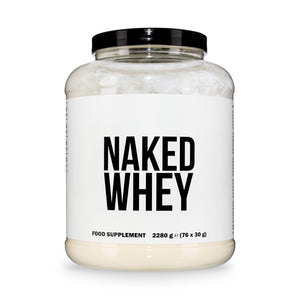
Naked Nutrition products are proud to only contain easily understandable ingredients, and all of our protein powders include one ingredient.