




På denna sida
Är kreatin veganskt? Vad växtbaserade idrottare behöver veta
Upptäck om kreatin passar en vegansk livsstil och hur växtbaserade idrottare säkert kan förbättra sin prestation med detta populära tillskott.

Viktiga slutsatser
- Kreatintillskott är veganska: Kommersiellt kreatinmonohydrat syntetiseras från icke-animaliska föreningar, vilket gör det helt veganskt.
- Kreatin från mat är inte veganskt: Kostkreatin kommer uteslutande från kött, fisk, fågel och ägg – växtbaserade livsmedel innehåller inget.
- Veganer kan ha mest nytta: Eftersom de börjar från lägre grundnivåer ser veganer vanligtvis större ökningar i muskelkreatinnivåer efter tillskott jämfört med allätare.
- Var försiktig med kapselvarianter: Många kreatinkapslar använder nötköttsgelatin. Välj pulver eller verifierade veganska kapslar.
- Se efter Certified Vegan-logotypen: Detta säkerställer att produkten inte innehåller några animaliska ingredienser och inte testats på djur.
- Standarddos är 3 till 5 g per dag: Uppladdning är valfri. Regelbunden daglig användning når full muskelsaturation på 3 till 4 veckor.

Kreatinmonohydratpulver | Naked Creatine - 2,2 LB
- Fri frakt ingår
- Kreatinmonohydrat
- Kreatinformel
- Evidensbaserade formler
Är kreatin veganskt? Det korta svaret

Ja. De flesta kreatintillskott är helt veganska. Kreatinpulvret du hittar på ett kosttillskottsbord är inte utvunnet från djur – det syntetiseras i ett laboratorium från icke-animaliska kemiska föregångare. Inget kött, inget ben, inga animaliska biprodukter.
Förvirringen kommer från en legitim skillnad som är värd att förstå. Kreatin som en naturligt förekommande förening finns nästan uteslutande i djurmuskulatur. Rött kött, fågel och fisk är de främsta kostkällorna. Om du äter dessa livsmedel får du i dig kreatin. Om du inte gör det får du ingen meningsfull mängd från maten.
Men kreatin som tillskott är en helt annan historia. Kommersiellt kreatinmonohydrat tillverkas genom en helt syntetisk process som inte involverar några animaliska insatsvaror i något skede. Slutprodukten är kemiskt identisk med det kreatin dina muskler använder, och den produceras utan att skada eller använda några djur.
Det finns ett undantag att omedelbart uppmärksamma: kreatin i standardkapslar. Många kapselskal är gjorda av nötköttsgelatin, vilket inte är veganskt. Kreatinet inuti kan vara veganskt, men skalet är det inte. Pulverformat löser detta problem direkt.
Resten av denna artikel behandlar hur kreatin fungerar, varför veganer har större nytta av att komplettera med det än de flesta andra, vad man ska leta efter när man väljer produkt och hur man doserar det effektivt.
Vad är kreatin och hur fungerar det?

Kreatin är en naturligt förekommande förening som syntetiseras i kroppen från tre aminosyror: arginin, glycin och metionin. Det lagras främst i skelettmuskler, med mindre mängder i hjärnan och testiklarna, enligt Wyss och Kaddurah-Daouk (2000) [1]. Din lever, njurar och bukspottkörtel producerar tillsammans ungefär 1 gram kreatin per dag, som dokumenterats av Kreider et al. (2017) [2]. Resten, under normala omständigheter, kommer från maten.
Inuti muskelvävnaden lagras kreatin som fosfokreatin. Under högintensiv träning — sprint, tung lyftning, explosiva rörelser — förbrukar dina muskler adenosintrifosfat (ATP) i en takt som ditt aeroba energisystem inte kan matcha. Fosfokreatin träder in för att snabbt återbilda ATP, vilket förlänger varaktigheten och kraftuttaget i dessa ansträngningar. Antonio et al. (2021) [3] bekräftar att ökade fosfokreatinlager förbättrar träningskapacitet, prestation, muskeltillväxt och återhämtning.
Den avgörande begränsande faktorn är hur fulla dessa fosfokreatinlager är från början. Här spelar kosten en betydande roll. Kostkreatin kommer uteslutande från animaliska livsmedel: rött kött, fågel, fisk och skaldjur. Växtbaserade livsmedel innehåller inget kreatin.
- Din kropp lagrar kreatin i muskelvävnad som fosfokreatin
- Under intensiv träning donerar fosfokreatin snabbt en fosfatgrupp för att återbilda ATP — din primära energivaluta
- Fullare fosfokreatinreserver betyder mer energi tillgänglig under högintensiva set eller sprintar
- Kroppen producerar ~1 g kreatin dagligen själv; kostintaget fyller på resten
- Veganer får noll kreatin från mat, vilket gör att deras reserver är helt beroende av endogen produktion
För veganer innebär detta att endogen produktion på 1 gram per dag är den enda källan. Det räcker för att upprätthålla grundläggande funktion, men lämnar muskelkreatinreserverna mätbart lägre än vad allätare vanligtvis har. Tillskottet åtgärdar direkt detta gap.
Hur tillverkas kreatintillskott? (Och varför det är veganskt)

Kreatinmonohydrat, den mest undersökta och använda formen, tillverkas genom en helt syntetisk kemisk process. De två huvudsakliga föregångarna är natriumsarkosin (en derivat av aminosyran glycin) och cyanamid (en oorganisk kväveförening). Ingen av dem kommer från djur. Som fastställts i tillverkningspatenten granskade av Persky och Brazeau (2001) [4] och US Patent 5,719,319 [5], kombineras dessa föreningar under värme i en kontrollerad reaktor.
När reaktionen är klar kyls blandningen ner och genomgår en reningsprocess med centrifugering. Det resulterande materialet torkas och mals till ett fint vitt pulver — kreatinmonohydratet du hittar i tillskott. Inga animaliska produkter används i någon del av denna process, vilket bekräftas av US Patent 6,326,513 [6].
Andra kreatinformer — kreatin HCL, buffrat kreatin, kreatin etylester — produceras genom liknande syntetiska metoder och är generellt veganska enligt samma logik. Den aktiva ingrediensen i alla är fri från animalier.
📊 Vad forskningen säger
Den kommersiella syntesen av kreatinmonohydrat från natriumsarkosin och cyanamid — båda icke-animaliska föreningar — har varit industristandard i årtionden. Enligt Persky och Brazeau (2001) [4] ger denna process en ren kreatinprodukt som är kemiskt identisk med den som människokroppen producerar, utan några animaliska insatsvaror i någon tillverkningsfas.
Det enda verkliga undantaget är leveransformatet. Standardkapslar är gjorda av nötköttsgelatin, som kommer från djurcollagen. Kreatinet inuti är veganskt; kapseln är det inte. Om du är vegan, välj pulverformat eller leta specifikt efter veganska kapselprodukter som använder växtbaserade cellulosa-kapslar istället.
Varför veganer kan ha mest nytta av kreatintillskott

Kreatin gynnar i princip alla som använder det konsekvent. Men forskningen tyder på att veganer och vegetarianer har mest att vinna. Anledningen handlar om grundläggande reserver.
Eftersom växtbaserade livsmedel inte innehåller kreatin förlitar sig veganer helt på endogen syntes för att upprätthålla kreatinnivåerna i musklerna. Den där 1 gram per dag som produceras internt räcker för att upprätthålla normal metabol funktion, men lämnar musklernas fosfokreatinlager mätbart lägre än hos personer som också äter kött. Kreider et al. (2017) [2] bekräftar att vegetarianer och veganer vanligtvis har lägre vilande muskelkreatinkoncentration jämfört med allätare.
Lägre startlager innebär mer utrymme att fylla. Och när du har mer utrymme att fylla ger tillskott en större relativ respons. Studier har visat att vegetarianer upplever större ökningar i muskelns fosfokreatinkoncentration efter kreatintillskott än sina allätande motsvarigheter. Mer kreatin lagrat i muskeln översätts direkt till bättre prestationsökningar, större styrkeökningar och mer uttalade förbättringar i muskelmassa.
Den kognitiva aspekten är också värd att notera. Hjärnan upprätthåller sina egna kreatinlager, och dessa följer samma mönster: lägre hos personer som inte konsumerar kreatin via kosten. Kreatin spelar en roll i hjärnans energimetabolism, och ny forskning pekar på att tillskott stödjer kognitiv funktion — minne, bearbetningshastighet och motståndskraft mot mental trötthet. För veganer som också kan ha lägre intag av andra näringsämnen som stödjer hjärnan, som B12 och omega-3, ger detta ytterligare en anledning att överväga kreatin utanför gymmet.
Enkelt uttryckt: kreatin är ett av de mest effektiva tillskotten en vegansk idrottare kan ta. Baslinjebristen skapar möjligheten, och tillskottet fyller den effektivt.
Hälsofördelar med kreatin för veganska idrottare

Kreatins fördelar är väl dokumenterade i hundratals studier och sträcker sig över flera system i kroppen. För veganska idrottare stöder bevisen följande:
- Förbättrad prestation vid högintensiv träning: Mer fosfokreatin tillgängligt innebär mer ATP återbildas under explosiva eller tunga ansträngningar. Du kan träna hårdare, lyfta mer och upprätthålla insatsen längre innan trötthet uppstår. Antonio et al. (2021) [3] bekräftar detta i styrke- och kraftbaserade träningssammanhang.
- Ökad muskelmassa: Prestationsökningarna ackumuleras över tid till större muskelutveckling. Kreatin stimulerar också insulinliknande tillväxtfaktor-1 (IGF-1), ett hormon som direkt främjar proteinsyntesen i muskler, vilket visas av Burke et al. (2008) [8].
- Snabbare återhämtning: Kreatintillskott är kopplat till minskad muskelskada och inflammation efter intensiv träning, vilket förkortar tiden som behövs mellan passen.
- Cellvolymisering: Kreatin drar vatten in i muskelcellerna, vilket ökar den intracellulära volymen och bidrar till ett fylligare, tätare muskelutseende. Detta är intracellulär hydrering — inte subkutan svullnad. Rawson och Volek (2003) [9] noterar att denna effekt finns under aktivt tillskott och försvinner när tillskottet upphör.
- Stöd för hjärnhälsa: Forskning tyder på att kreatin kan stödja kognitiv funktion och erbjuda neuroprotektiva effekter relevanta för tillstånd som Parkinsons sjukdom och Alzheimers, enligt Beal (1999) [10] och Wyss och Schulze (2002) [11]. Bevis från mänskliga studier utvecklas fortfarande, men den mekanistiska grunden är solid.
Kreatinmonohydrat är en av de mest studerade föreningarna inom idrottsnutrition. Det anses vara säkert för friska vuxna vid långvarig användning, utan trovärdiga bevis på skada på njur- eller leverfunktion hos personer utan befintliga tillstånd.
Hur man väljer ett veganskt kreatintillskott
Inte alla kreatinprodukter är lika ur ett veganskt perspektiv. Här är vad du ska leta efter och vad du ska undvika.
- Sök efter Certified Vegan-logotypen: Utfärdad av Vegan.org, denna certifiering bekräftar att produkten är fri från alla animaliska ingredienser och inte testades på djur, enligt Vegan.org:s certifieringsstandarder [7]. Det är den tydligaste signalen du kan använda på etikettens nivå.
- Välj pulver eller veganska kapslar: Standardkapslar använder bovint gelatin. Pulver är den enklaste lösningen. Om du föredrar kapslar, kontrollera att kapseln är gjord av cellulosa (växtbaserad), inte gelatin.
- Håll dig till ren kreatinmonohydrat: Ju färre ingredienser, desto bättre. Många pre-workout-blandningar innehåller kreatin, men de innehåller också sötningsmedel, artificiella smaker, stimulanser och andra tillsatser som kanske inte passar dina koststandarder eller träningsbehov.
- Sök efter tredjepartstestning: Certifieringar från NSF Certified for Sport eller Informed Sport verifierar att en produkt har testats oberoende för etikettens korrekthet och frånvaro av förbjudna ämnen. Detta är viktigt för tävlingsidrottare och alla som vill vara säkra på vad de faktiskt konsumerar.
📊 Vad forskningen säger
Kreatinmonohydrat är fortfarande den mest forskningsstödda formen som finns. Enligt Antonio et al. (2021) [3] har ingen annan kreatinform visat sig överträffa den när det gäller muskelmättnad, prestation eller säkerhet. Pulver med en enda ingrediens, monohydrat, är det rationella standardvalet.
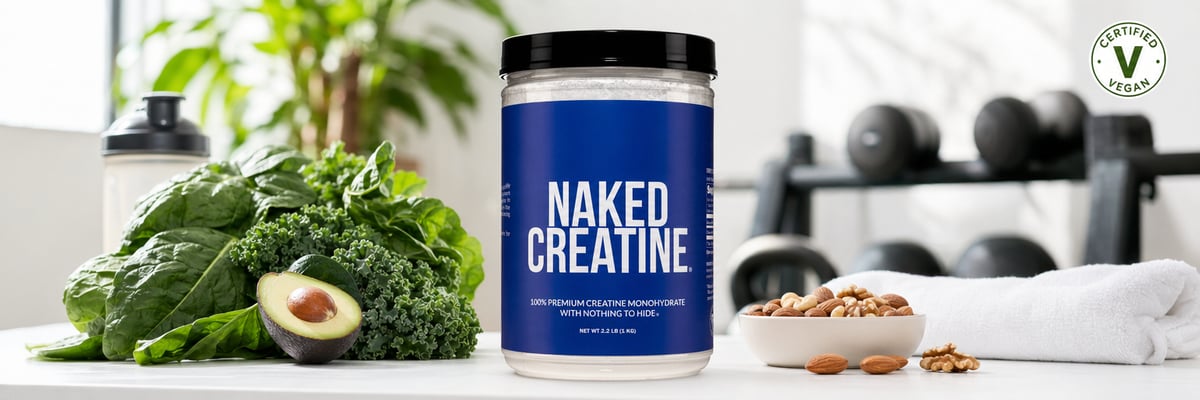
Naked Creatine är ett kreatinmonohydratpulver med en enda ingrediens som bär Certified Vegan-logotypen, innehåller inga tillsatser eller fyllmedel och tillverkas med full ingrediensgenomskinlighet. För veganer som vill ha det enklaste och renaste alternativet täcker det alla ovanstående kriterier utan kompromisser.
Hur mycket kreatin bör veganer ta?

Den standardiserade underhållsdosen av kreatin är 3-5 gram per dag . Tas det konsekvent räcker detta för att successivt mätta muskelns fosfokreatinförråd över 3 till 4 veckor. För de flesta är detta tillvägagångssätt enklare, mer bekvämt och lika effektivt på lång sikt.
Vissa väljer att använda en laddningsfas för att snabbare nå full mättnad. Detta innebär att ta 20 till 25 gram per dag, uppdelat i 4 till 5 doser på cirka 5 gram vardera, i 5 till 7 dagar. Efter laddning minskar man till en standard underhållsdos på 3 till 5 gram dagligen. Lanhers et al. (2017) [14] bekräftar att denna metod uppnår full muskelmättnad betydligt snabbare än utan laddning.
Laddning är frivillig. Nackdelen är att höga dagliga doser kan orsaka mag-tarmbesvär hos vissa — uppblåsthet, kramper eller lös avföring. Att dela upp doserna under dagen minskar risken, men eliminerar den inte helt. Om ditt matsmältningssystem är känsligt, hoppa över laddning och använd istället den dagliga dosen.
När det gäller timing: kreatin kan tas när som helst under dagen. Intag efter träning tillsammans med kolhydrater kan marginellt förbättra upptaget genom att utnyttja insulinmedierad transport in i muskelcellerna, men skillnaden är liten. Konsekvens är mycket viktigare än exakt timing.
Specifikt för veganer: eftersom ni börjar från en lägre nivå än de flesta allätare är det särskilt viktigt att prioritera dagligt tillskott utan uppehåll. Det finns ingen fördel med att cykla av och på — kreatin fungerar genom att upprätthålla förhöjda muskelreserver, och avbrott motverkar detta.
Vanliga frågor
Är kreatin veganskt?
De flesta kreatintillskott på marknaden idag är veganska eftersom de syntetiskt produceras i laboratorium från två föreningar — sarkosin och cyanamid — istället för att utvinnas från djurkällor. Det är dock alltid viktigt att kontrollera etiketten och leta efter produkter som är certifierat veganska, eftersom vissa formuleringar kan innehålla icke-veganska tillsatser eller fyllmedel. Naked Nutritions Creatine Monohydrate är till exempel 100 % vegansk och innehåller inga ingredienser från djurriket.
Var kommer kreatin naturligt ifrån?
I naturen finns kreatin nästan uteslutande i animaliska livsmedel som rött kött, fågel och fisk, vilket är anledningen till att veganer och vegetarianer tenderar att ha lägre grundnivåer av kreatin än allätare. Människokroppen producerar också små mängder kreatin naturligt i levern, njurarna och bukspottkörteln med hjälp av aminosyrorna glycin, arginin och metionin. Eftersom intaget av kreatin via kosten är minimalt eller obefintligt på en växtbaserad diet kan tillskott vara särskilt fördelaktigt för veganer.
Hur tillverkas syntetiskt kreatin och varför anses det vara veganskt?
Syntetiskt kreatinmonohydrat tillverkas genom en kemisk process som kombinerar sarkosin och cyanamid under kontrollerade värme- och tryckförhållanden — inga djur eller djurprodukter är involverade i någon del av processen. Det resulterande kreatinet är molekylärt identiskt med det kreatin som finns i kött, vilket innebär att kroppen bearbetar det på exakt samma sätt. Detta gör laboratorietillverkat kreatin till ett rent, etiskt val för dem som följer en vegansk livsstil.
Behöver veganer verkligen ta kreatintillskott?
Även om kreatintillskott inte är absolut nödvändigt för veganer visar forskning konsekvent att växtbaserade ätare har lägre kreatinförråd i musklerna jämfört med köttätare, vilket kan påverka idrottsprestation och kognitiv funktion. Studier har visat att veganer som tar kreatintillskott upplever större prestationsförbättringar än sina allätande motsvarigheter, sannolikt på grund av en större "laddningseffekt" från deras lägre grundnivåer. För aktiva veganer kan ett tillskott av kreatin särskilt bidra till att minska gapet som orsakas av frånvaron i kosten.
Vilka är fördelarna med kreatin för veganska idrottare?
Kreatintillskott stödjer ökad produktion av adenosintrifosfat (ATP), den primära energivalutan som används vid högintensiv, kortvarig träning som tyngdlyftning och sprint. För veganska idrottare som börjar med lägre kreatinmättnad i musklerna kan tillskott leda till märkbara förbättringar i styrka, kraftutveckling, muskelåterhämtning och till och med kognitiv prestation. Dessa fördelar är väl underbyggda av decennier av vetenskaplig forskning, vilket gör kreatin till ett av de mest evidensbaserade tillskotten som finns.
Hur mycket kreatin bör en vegan ta per dag?
Den vanligaste rekommenderade underhållsdosen av kreatin är 3–5 gram per dag, vilket är tillräckligt för att mätta muskelns kreatinförråd över tid vid regelbunden användning. Vissa väljer att göra en "laddningsfas" med 20 gram per dag (uppdelat i fyra doser) under de första 5–7 dagarna för att nå mättnad snabbare, även om detta steg är valfritt och inte nödvändigt för långsiktiga resultat. Eftersom veganer börjar med lägre grundnivåer kan de reagera särskilt bra på både laddnings- och underhållsprotokoll.
Är kreatintillskott säkert för veganer?
Kreatinmonohydrat är ett av de mest omfattande studerade kosttillskotten i världen och har en väl etablerad säkerhetsprofil för friska individer, inklusive veganer. Det påverkar inte negativt växtbaserade dieter och kräver inga särskilda kostjusteringar för att användas effektivt. Som med alla tillskott bör personer med befintliga njurproblem rådgöra med en vårdgivare innan de börjar med kreatin, eftersom njurarna spelar en roll i kreatinmetabolismen.
Vad bör veganer leta efter när de väljer ett kreatintillskott?
Veganer bör leta efter kreatinprodukter som uttryckligen är märkta som vegancertifierade och helst testade av tredje part för att verifiera både renhet och frånvaro av animaliska ingredienser eller korskontaminering. Det är också värt att kontrollera onödiga tillsatser som gelatin-kapslar, mejeribaserade fyllmedel eller konstgjorda färgämnen som kan äventyra produktens veganställning. Att välja ett enkelt kreatinmonohydratpulver med en enda ingrediens — som Naked Creatine — är ofta det renaste och mest transparenta alternativet som finns.
Toppval av produkter
Valt av över 1 miljon kunder. Fri frakt vid beställningar över 100 $.
Kreatinmonohydratpulver | Naked Creatine - 2,2 LB
$35.99
- ✓ 100 % premium kreatinmonohydrat
- ✓ Högsta tillgängliga kvalitet: löser sig snabbt och absorberas snabbt
- ✓ 5 g kreatin per portion
- ✓ Inga konstgjorda sötningsmedel, smaker eller färgämnen

Jordgubb Kreatinmonohydratpulver | Naked Creatine - 1,1 LB
$29.99
- ✓ 100 % premium kreatinmonohydrat
- ✓ Högsta tillgängliga kvalitet: löser sig snabbt och absorberas snabbt
- ✓ 5 g kreatin per portion
- ✓ Inga konstgjorda sötningsmedel, smaker eller färgämnen

Citrongräs Lime Kreatinmonohydratpulver | Naked Creatine - 1,1 LB
$29.99
- ✓ 100 % premium kreatinmonohydrat
- ✓ Högsta tillgängliga kvalitet: löser sig snabbt och absorberas snabbt
- ✓ 5 g kreatin per portion
- ✓ Inga konstgjorda sötningsmedel, smaker eller färgämnen