




On this page
How Much Water to Drink With Creatine for Best Results
Stay hydrated and maximize your gains by knowing exactly how much water to pair with your daily creatine dose.

Key Takeaways
- Core rule: Mix each creatine dose with at least 8 oz of water, regardless of which phase you're in.
- Loading phase: Drink 3 to 4 liters of water per day during the 5 to 7 day loading protocol (20g/day split into four doses).
- Maintenance phase: 2 to 3 liters per day is sufficient for most people taking 3 to 5g daily.
- Why it matters: Creatine pulls water into muscle cells. If you're not adequately hydrated, creatine can't do its job and side effects like cramping become more likely.
- Don't overdo it: Excessive water intake carries its own risks. Hit your targets consistently rather than drinking large amounts at once.
- Safety profile: Creatine is one of the most well-researched supplements available. Proper hydration eliminates most of the commonly reported side effects.

Creatine Monohydrate Powder | Naked Creatine - 2.2LB
- Free Shipping Included
- Creatine Monohydrate
- Creatine Formula
- Evidence-Based Formulas
How Much Water to Drink With Creatine: The Direct Answer

The answer is straightforward: mix each dose with 8 oz (240ml) of water, and drink 2 to 4 liters of total fluid per day depending on where you are in your supplementation protocol. Those two numbers shift based on one variable: whether you're in the loading phase or the maintenance phase.
During the loading phase (20g per day for 5 to 7 days), aim for 3 to 4 liters of total daily fluid. During the maintenance phase, the maintenance dose for creatine is 3-5 grams per day , 2 to 3 liters is adequate for most people. Both phases require the same mixing rule: 8 oz per dose, minimum.
The reason hydration requirements shift between phases is straightforward. Higher creatine doses amplify the osmotic effect on muscle cells, pulling more water into tissue and increasing your body's demand for fluid replacement. Get this right, and creatine performs as advertised. Get it wrong, and you're leaving results on the table while increasing the risk of avoidable side effects.
Quick Reference: Creatine Water Targets by Phase
- Loading phase: 20g/day in four 5g doses — mix each with 8 oz water — total daily fluid: 3 to 4 liters
- Maintenance phase: 3 to 5g/day in one dose — mix with 8 oz water — total daily fluid: 2 to 3 liters
- Heavy training or hot environments: Add another 500ml to 1 liter on top of these baselines
Why Hydration Matters When Taking Creatine

Creatine works partly through an osmotic mechanism: it draws water into skeletal muscle cells. This intracellular hydration is part of what drives the performance and hypertrophy benefits. But that mechanism only works properly when your body has enough water to move into those cells in the first place.
Here's how it connects to performance: creatine is stored in muscles as phosphocreatine, which the body uses to rapidly regenerate adenosine triphosphate (ATP) during high-intensity exercise. ATP is the fuel your muscles run on during short, explosive efforts. More phosphocreatine means more ATP available, which means more reps, more power output, and faster recovery between sets. Adequate hydration keeps this system running efficiently.
When fluid intake is insufficient, two things happen. First, creatine supplementation 's uptake into muscle cells is blunted, reducing its effectiveness. Second, the osmotic pull of creatine competing with your body's normal fluid balance can produce symptoms associated with dehydration even when you're not technically in a deficit.
- Creatine enters muscle cells via osmosis, bringing water with it to increase cell volume
- Cell volumization signals anabolic pathways, supporting muscle protein synthesis
- Phosphocreatine stores replenish ATP faster than any other energy system during intense effort
- Inadequate hydration limits creatine uptake and reduces the intracellular water content that supports these processes
- Watch for early dehydration signs: dark urine, headache, dry mouth, and muscle tightness during exercise
Water Intake During the Creatine Loading Phase

The loading phase saturates your muscle creatine stores rapidly. The standard protocol, documented in creatine supplementation research, is 20 grams per day divided into four 5g doses over 5 to 7 days. Each of those doses gets mixed with at least 8 oz of water, giving you roughly 40 oz of additional fluid just from mixing alone.
But 40 oz from mixing isn't your total target. Your goal for total daily fluid during loading is 3 to 4 liters (approximately 100 to 135 oz). This is roughly 1.5 to 2 times your baseline intake. The higher volume is necessary because creatine is aggressively pulling water into muscle tissue at this stage, and your kidneys also need adequate fluid to process the increased creatine turnover.
Practical tips for the loading phase:
- Space your four doses evenly through the day (morning, midday, afternoon, evening) to distribute both the creatine load and your fluid intake
- Don't try to hit your water target in one or two sittings — consistent sipping throughout the day is more effective
- If you train in a hot environment or sweat heavily, add at least 500ml to 1 liter on top of the 3 to 4 liter baseline
- Consider pairing doses with meals to reduce the chance of GI discomfort
The loading phase is short. Seven days of disciplined hydration is a manageable ask, and it sets the foundation for everything that follows.
Water Intake During the Creatine Maintenance Phase
Once your muscles are saturated, the maintenance phase keeps them that way. The standard maintenance dose is 3 to 5 grams per day. Mix it with 8 oz of water, and target 2 to 3 liters of total daily fluid. For most people, this is close to what they should already be drinking.
Body weight matters here. Larger individuals and those with higher training volumes sit at the upper end of that range. A 200-pound athlete training twice a day needs more fluid than a 140-pound person doing three moderate sessions per week. If you're unsure where you fall, use urine color as your guide: pale yellow means you're well hydrated; dark yellow or amber means drink more.
A few things worth noting for the maintenance phase:
- You don't need to chase the 3 to 4 liter loading-phase target once you're in maintenance. That level of intake isn't necessary and doesn't add benefit.
- Food contributes meaningfully to hydration. Fruits, vegetables, and other water-rich foods can account for 20 to 30 percent of your daily fluid intake, so factor that in if you eat a whole-food-heavy diet.
- Creatine dissolves cleanly in water, so there's no clumping concern. Mix it, drink it, done.
📊 What Research Says
A study published in Medicine and Science in Sports and Exercise found that participants who supplemented with creatine and maintained adequate hydration showed significantly lower levels of muscle damage markers and inflammatory cytokines post-exercise compared to placebo groups. Researchers concluded that creatine's recovery benefits are closely tied to consistent fluid availability in muscle tissue — reinforcing why maintenance-phase hydration isn't optional even when the doses are smaller.
Tips for Staying Hydrated on Creatine

Knowing your daily fluid target and consistently hitting it are two different things. These practical strategies make the difference.
Distribute intake throughout the day. Drinking 500ml to 750ml with each of four to six meals or snack periods keeps hydration steady. Downing a liter at once doesn't hydrate you more efficiently — it just sends most of it to your kidneys faster.
Monitor urine color. Pale straw yellow is your target. Check it first thing in the morning and after training. It's a fast, free feedback tool that tells you whether yesterday's and this morning's intake was adequate.
Consider electrolytes if you train hard. If you're training intensely, sweating heavily, or exercising in heat, plain water alone may not be enough. Sodium, potassium, and magnesium help retain fluid at the cellular level. A balanced electrolyte supplement or sodium-containing food with your fluid intake can help.
Watch the caffeine. High caffeine intake — multiple cups of coffee plus pre-workout stimulants — has a mild diuretic effect and can work against your hydration goals. For more on this topic, see Can You Put Creatine in Coffee . Moderate caffeine use isn't a problem, but excessive amounts compound the fluid demands that creatine places on your system.
Don't take creatine on an empty stomach. GI discomfort from creatine is most commonly reported when it's taken without food. Take it with a meal or a protein shake and the issue largely disappears.
Avoid overhydration. Drinking far beyond your needs isn't protective — it's its own risk. Extremely high water intake without adequate sodium can dilute blood sodium levels, causing hyponatremia. Stay within the 2 to 4 liter range appropriate for your phase.
Benefits of Taking Creatine (And Why Hydration Supports Them)

Creatine's benefits are well-documented, but they're not automatic. Each of the major performance and health outcomes depends, to varying degrees, on your muscles being adequately hydrated to absorb and utilize creatine effectively.
Improved strength and high-intensity performance. This is the most established benefit. Creatine enhances the phosphocreatine system, enabling faster ATP regeneration during sprints, heavy lifts, and explosive movements. Research consistently shows improvements in strength and power output across trained and untrained populations.
Increased lean muscle mass. When combined with resistance training, creatine promotes muscle protein synthesis and reduces muscle protein breakdown. The intracellular water retention from creatine also contributes to cell volumization, which is an anabolic signal in its own right. The result over weeks of training is measurable increases in lean tissue.
Faster muscle recovery. Creatine reduces markers of muscle damage and inflammation post-exercise. Hydration amplifies this effect by supporting nutrient delivery to muscle tissue and waste removal after training.
Cognitive benefits. The brain stores phosphocreatine and depends on ATP just like muscles do. Emerging research suggests creatine supplementation may improve memory and cognitive function, particularly in older adults . Early work also points to possible protective effects against neurodegenerative conditions like Alzheimer's and Parkinson's disease, though this research is still developing and clinical applications remain under investigation.
Therapeutic applications. Creatine has shown promise in managing symptoms of muscular dystrophy and other neuromuscular conditions. These are not yet established clinical treatments, but the evidence base is growing.
Potential Side Effects of Creatine and How Hydration Prevents Them

Creatine has an excellent safety record. The side effects most people encounter are mild, predictable, and almost entirely preventable with proper hydration and dosing.
Muscle cramps are the most commonly cited complaint. They're also the most directly tied to hydration. When creatine draws water into muscle cells but total body fluid is insufficient, local dehydration in working muscles can trigger cramping. Drink enough water and this issue largely disappears.
Water retention and temporary weight gain catch people off guard, especially in the first week. The scale goes up, often by 1 to 3 pounds, and people assume something is wrong. Nothing is wrong. This is intramuscular water — the exact mechanism that supports creatine's performance benefits. It's not fat gain. It's not bloating from excess fluid. It resolves or stabilizes within one to two weeks as your body adjusts.
Digestive discomfort is most common during the loading phase when doses are higher. Reduce individual doses, take creatine with food rather than on an empty stomach, and ensure you're drinking adequate water with each dose. These three adjustments resolve GI issues for most people.
Kidney concerns are frequently raised but not supported by evidence in healthy individuals using standard doses. Long-term studies at 3 to 5g per day have not shown adverse effects on kidney function in people without pre-existing renal conditions.
- Creatine monohydrate is one of the most studied sports supplements in existence, with decades of research supporting its safety
- Most reported side effects (cramps, GI discomfort) are dose-dependent or hydration-dependent, not inherent to the compound
- Temporary weight gain from intramuscular water retention is a feature of how creatine works, not a side effect to avoid
- Kidney concerns apply to individuals with pre-existing renal conditions — healthy individuals at standard doses have no documented risk
- Stick to 3 to 5g daily during maintenance: higher doses don't increase benefits but do increase the likelihood of GI issues
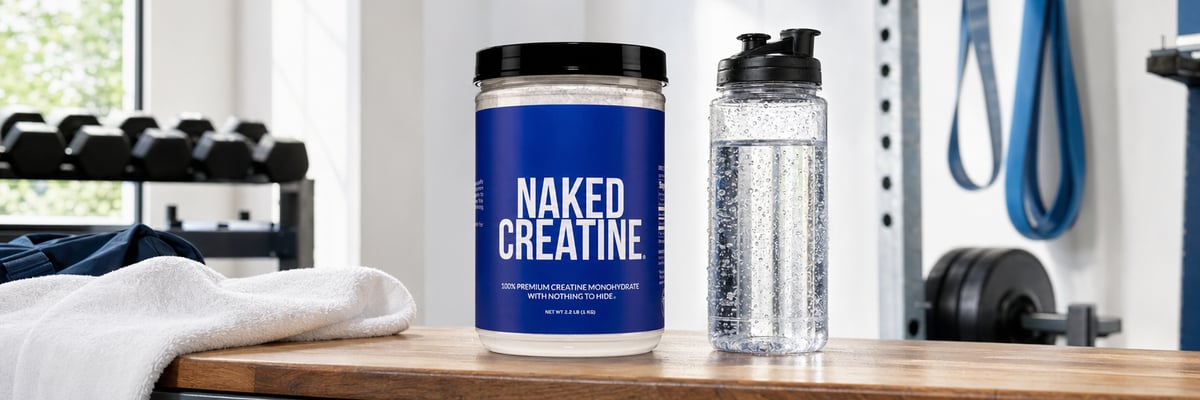
If you want a creatine product with no fillers, no artificial ingredients, and nothing but pure creatine monohydrate, Naked Creatine delivers exactly that. One ingredient. Thoroughly tested. The cleaner your supplement, the fewer variables you're managing alongside your hydration protocol.
Frequently Asked Questions
How much water should you drink with creatine each day?
Most experts recommend drinking at least 8–10 cups (64–80 ounces) of water per day when supplementing with creatine, though highly active individuals may need more. Since creatine draws water into your muscle cells, your total hydration needs increase compared to days when you are not supplementing. A practical rule of thumb is to add at least 16–20 extra ounces of water on top of your usual daily intake.
Do you need to drink more water during a creatine loading phase?
Yes, the loading phase — typically 20 grams per day split into four doses for 5–7 days — places a greater demand on your body's fluid balance because more creatine is being pulled into muscle tissue. During this period, aim for at least 3–4 liters of water daily to support proper absorption and minimize side effects like bloating or cramping. Spreading both your creatine doses and your water intake evenly throughout the day is the most effective strategy.
What happens if you don't drink enough water while taking creatine?
Insufficient hydration while taking creatine can lead to muscle cramps, digestive discomfort, headaches, and in more serious cases, dehydration. Because creatine pulls water into your muscles, less fluid remains circulating in your bloodstream and other tissues if you are not compensating with adequate intake. Over time, chronic dehydration while supplementing may also reduce the effectiveness of creatine itself, since optimal cell hydration is key to its performance benefits.
Should you mix creatine directly with water or another beverage?
Creatine can be mixed with plain water, juice, or a protein shake, though plain water is the simplest and most cost-effective option. Some research suggests that pairing creatine with a carbohydrate-containing drink like juice may slightly enhance uptake due to the insulin response, though the difference is modest for most people. Regardless of what you mix it with, drinking additional plain water throughout the day remains important for overall hydration.
Does creatine cause water retention, and is that harmful?
Creatine does cause intracellular water retention, meaning it draws water inside muscle cells rather than under the skin, which is why users often notice a slight increase in body weight early on. This type of water retention is not harmful and is actually a sign that the supplement is working as intended. It is distinct from the bloated, subcutaneous water retention associated with high sodium intake or certain medications.
How do I know if I'm drinking enough water while taking creatine?
The easiest way to monitor hydration is to check the color of your urine — pale yellow or straw-colored urine generally indicates you are well-hydrated, while dark yellow or amber urine signals you need to drink more. You should also pay attention to signs like dry mouth, fatigue, or muscle cramps, which can indicate inadequate fluid intake. Tracking your daily water consumption with a marked water bottle is a simple, reliable way to stay on target.
Does exercising in the heat change how much water you need with creatine?
Absolutely — exercising in hot or humid conditions significantly increases sweat rate, which means your hydration needs are even higher when combining heat exposure with creatine use. In these conditions, some athletes may need upward of 4–5 liters of water per day to stay properly hydrated. Electrolytes like sodium, potassium, and magnesium also become more important in hot weather to replace what is lost through sweat and to support muscle function.
Is it safe to take creatine long-term, and does the water requirement change over time?
Creatine is one of the most extensively studied sports supplements available and has a strong safety record for long-term use in healthy individuals at standard doses of 3–5 grams per day. Your water requirements during long-term maintenance dosing are generally lower than during the loading phase, but you should still aim to drink more than your baseline daily intake. Staying consistently well-hydrated not only supports creatine's effectiveness but also promotes kidney health, which is important for anyone using any supplement regularly.
Top Product Picks
Chosen by 1 million+ customers. Free shipping on orders over $100.
Creatine Monohydrate Powder | Naked Creatine - 2.2LB
$35.99
- ✓ 100% premium creatine monohydrate
- ✓ Highest grade available: fast dissolving and quickly absorbed
- ✓ 5g of creatine per serving
- ✓ No artificial sweeteners, flavors, or colors

Strawberry Creatine Monohydrate Powder | Naked Creatine - 1.1LB
$29.99
- ✓ 100% premium creatine monohydrate
- ✓ Highest grade available: fast dissolving and quickly absorbed
- ✓ 5g of creatine per serving
- ✓ No Artificial Sweeteners, Flavors, or Colors

Lemon Lime Creatine Monohydrate Powder | Naked Creatine - 1.1LB
$29.99
- ✓ 100% premium creatine monohydrate
- ✓ Highest grade available: fast dissolving and quickly absorbed
- ✓ 5g of creatine per serving
- ✓ No artificial sweeteners, flavors, or colors