




On this page
How Long Does Creatine Take to Work? What to Expect
Discover exactly when creatine starts boosting your strength, muscle gains, and performance — and how to speed up your results.

Key Takeaways
- Standard dosing timeline: Taking 3–5g of creatine daily produces noticeable results in 3–4 weeks as phosphocreatine stores gradually saturate.
- Loading protocol timeline: A loading phase of 20–25g/day for 5–7 days reaches peak muscle saturation faster, with results appearing in as little as 5–7 days.
- Individual variation matters: Baseline creatine levels, diet, body weight, and training frequency all influence how quickly creatine starts working for you.
- Vegans and vegetarians respond faster: Lower dietary creatine intake means more room for supplementation to make an impact.
- Safety is well-established: The International Society of Sports Nutrition (ISSN) confirms creatine is safe at doses up to 30g/day for healthy individuals.
- Benefits go beyond muscle: Creatine supports brain health, injury recovery, blood sugar regulation, and quality of life in older adults.
- Creatine monohydrate is the gold standard: No other form has been shown to outperform it in research or real-world results.

Creatine Monohydrate Powder | Naked Creatine - 2.2LB
- Free Shipping Included
- Creatine Monohydrate
- Creatine Formula
- Evidence-Based Formulas
How Long Does Creatine Take to Work? The Short Answer

If you've just started taking creatine and you're waiting to feel something, here's the direct answer: it takes 7 to 28 days to see measurable improvements in strength and performance. The wide range comes down to how you're dosing and how much creatine your muscles already hold.
With a loading protocol (20–25g/day for 5–7 days), your muscles reach saturation quickly and you can expect results within a week. With standard daily dosing (3–5g/day), the same saturation point is reached in 3–4 weeks. The end destination is identical. Only the speed differs.
Your individual starting point also matters. Someone who eats red meat daily already has higher baseline phosphocreatine stores than a vegan athlete. The vegan will likely notice effects sooner because there's more room to fill. Your body weight, muscle mass, training volume, and consistency with supplementation all shape the timeline too.
The rest of this article breaks down exactly why those factors matter and how to use that knowledge to get results faster.
How Creatine Works in the Body

Every explosive movement you make — a heavy squat, a sprint, a box jump — runs on ATP (adenosine triphosphate). ATP is your muscles' immediate fuel source, but stores are tiny. Under maximum effort, your body exhausts available ATP in roughly 10 seconds. What happens next determines how hard you can keep pushing.
This is where phosphocreatine comes in. Stored in muscle tissue, phosphocreatine donates a phosphate group to spent ADP molecules, rapidly regenerating ATP and extending your capacity for high-intensity output. The more phosphocreatine you have stored, the longer and harder your muscles can work before fatigue sets in.
- ATP powers every muscle contraction but depletes in approximately 10 seconds of maximal effort.
- Phosphocreatine rapidly regenerates ATP by donating a phosphate group to ADP.
- Supplementing raises phosphocreatine stores by 10–40%, directly increasing your ceiling for power output.
- The brain also stores phosphocreatine and relies on ATP — which explains creatine's cognitive benefits.
Your body produces creatine naturally from the amino acids glycine and arginine, primarily in the liver and kidneys. Dietary sources — red meat, fish, poultry — contribute additional creatine. But even with a balanced omnivore diet, most people's muscles are only about 60–80% saturated. Supplementation closes that gap, which is the entire point.
Vegetarians and vegans get little to no dietary creatine, so their baseline stores tend to sit near the lower end of that range. That's actually an advantage when supplementing: the gap is bigger, so the response is often faster and more pronounced.
Factors That Affect How Fast Creatine Starts Working

If creatine hasn't seemed to do much yet, it's worth looking at these variables before concluding it isn't working. The timeline is genuinely different from person to person.
- Baseline creatine levels: Meat eaters have higher baseline stores. They'll experience a smaller, slower increase. Vegans and vegetarians start lower and tend to saturate more noticeably and more quickly.
- Dosing method: Loading saturates muscles in 5–7 days. Standard dosing takes 3–4 weeks. This is the single biggest controllable factor in your timeline.
- Training frequency and intensity: The more you train, the faster your body depletes and replenishes phosphocreatine stores, which accelerates the saturation signal. Someone training five days a week will likely notice effects sooner than someone training twice a week.
- Body weight and muscle mass: Larger individuals have more muscle tissue to saturate. A 100kg athlete may need longer to reach full saturation on a standard 5g/day dose than a 65kg person.
- Consistency: Skipping doses slows saturation. Creatine needs to be taken daily, including rest days, to maintain and build stores.
The most common reason people don't notice results is inconsistent dosing, not a failure of creatine itself. Take it every day, train with adequate intensity, and the timeline above holds up.
Creatine Loading vs. Standard Dosing: Which Is Right for You?

Both strategies work. The question is how fast you need results and how well your stomach tolerates higher doses.
Creatine loading means taking 20–25g per day, split into four or five 5g doses, for 5–7 days. After that, you drop to a maintenance dose of 3–5g per day. Research confirms this approach can increase muscle creatine stores by 10–40% within the loading window. To personalize the loading dose, multiply your body weight in kilograms by 0.3 — a 90kg athlete would load at approximately 27g/day.
Standard dosing skips the loading phase entirely. You take 3–5g per day from day one and reach the same saturation point in 3–4 weeks. No accelerated schedule, no need to split doses.
| Factor | Loading Protocol | Standard Dosing |
|---|---|---|
| Daily dose | 20–25g (split 4–5x) | 3–5g (single dose) |
| Time to full saturation | 5–7 days | 3–4 weeks |
| GI side effect risk | Higher | Low |
| Best for | Competitors, near-term performance goals | Long-term use, sensitive stomachs |
| End result | Full muscle saturation | Full muscle saturation |
Loading makes sense if you have a competition, race, or performance test within the next two weeks. For everyone else, standard dosing delivers the same outcome with less complexity and fewer potential side effects. There's no metabolic advantage to loading once both approaches have reached full saturation — the maintenance phase is identical either way.
Is Creatine Loading Safe? Side Effects to Know

The short answer is yes. The International Society of Sports Nutrition has reviewed the evidence extensively and concluded that creatine supplementation at doses up to 30g per day is safe and well tolerated by healthy individuals. That's above and beyond what a loading protocol requires.
That said, some people do experience side effects during the loading phase:
- GI discomfort: Nausea, diarrhea, and stomach cramps are the most common complaints. Splitting your daily loading dose into four or five smaller servings rather than taking it all at once significantly reduces this risk.
- Water retention and temporary weight gain: Creatine draws water into muscle cells. This is a normal physiological response, not fat gain. The scale may move 1–2kg in the first week.
📊 What Research Says
A widely circulated concern about creatine is that it causes dehydration and muscle cramping. Current scientific evidence contradicts this directly — and the ISSN's position paper goes further, noting that creatine may actually reduce the incidence of cramping and heat-related illness in athletes training in hot conditions.
One important exception: individuals with pre-existing kidney conditions or those on medications that affect renal function should speak with a healthcare provider before loading. For healthy people, the evidence for safety across long-term use is robust.
When to Take Creatine for Best Results

Timing creatine matters less than taking it consistently, but it's not entirely irrelevant. Once ingested, blood levels of creatine peak approximately 60 minutes after oral ingestion. That window informs the pre-workout recommendation.
The pre- vs. post-workout debate has real research behind it. One study found greater lean mass and strength gains when creatine was taken after exercise compared to before. Other studies favor pre-workout timing. The consensus from the evidence is practical: take creatine close to your training session, either before or after. If you want to cover both windows, split the dose — 2.5g pre-workout and 2.5g post-workout.
Taking creatine with carbohydrates or a mixed meal that includes protein and carbs may enhance uptake by stimulating insulin, which helps drive creatine into muscle cells. This isn't mandatory, but it's a useful pairing if you're already eating around your training.
On rest days, timing is essentially irrelevant. Take your maintenance dose at whatever point in the day you'll actually remember to take it. The goal on non-training days is simply maintaining the stores you've built, not optimizing for acute performance.
Benefits of Creatine Beyond the Gym

Creatine's reputation is built on athletic performance, but the research extends well beyond the weight room.
Muscle growth: Creatine monohydrate promotes muscle growth in both the short and long term when combined with resistance training. In one study, weightlifters supplementing with creatine doubled lean body mass gains and increased their one-rep max on bench press compared to a placebo group.
Strength and power: The mechanism is direct. More phosphocreatine available means more ATP regenerated during high-intensity efforts, which translates to measurable improvements in strength, power output, and anaerobic endurance.
Injury prevention and recovery: Evidence suggests creatine reduces injury severity, supports rehabilitation, and helps athletes tolerate heavier training loads over time. These aren't minor secondary effects — they can meaningfully extend an athlete's training lifespan.
Brain health: The brain stores phosphocreatine and depends heavily on ATP. Research links creatine supplementation to improvements in short-term memory and intelligence scores, and preliminary findings suggest neuroprotective effects relevant to conditions like Parkinson's and Alzheimer's disease.
Metabolic health: Emerging research points toward creatine's role in blood sugar regulation and potential applications in managing nonalcoholic fatty liver disease. More clinical data is needed, but the early signals are promising.
Special populations: Older adults see particular benefit — creatine combined with a resistance program improves leg strength and muscle mass, directly supporting independence and quality of life. Vegetarians, vegans, and women are also groups where the response to creatine tends to be more pronounced, given lower baseline stores and historically lower supplementation rates.
Which Type of Creatine Should You Choose?
Walk into any supplement store and you'll find creatine hydrochloride, buffered creatine (Kre-Alkalyn), creatine ethyl ester, and a dozen branded variations. Most of them carry premium price tags and claims of superior absorption or reduced bloating. The research doesn't support those claims.
Creatine monohydrate is the gold standard. It's the form used in the vast majority of clinical studies, the one that produced every performance and health benefit described in this article, and the most cost-effective option available. No alternative form has been shown in peer-reviewed research to outperform it on any meaningful outcome.
- Creatine monohydrate as the sole or primary ingredient.
- No artificial sweeteners, fillers, or unnecessary additives.
- Unflavored options are the most versatile — mix into water, juice, or a protein shake.
- Third-party testing or certification for purity and accurate labeling.
- Transparent labeling: the dose per serving should be clearly stated.
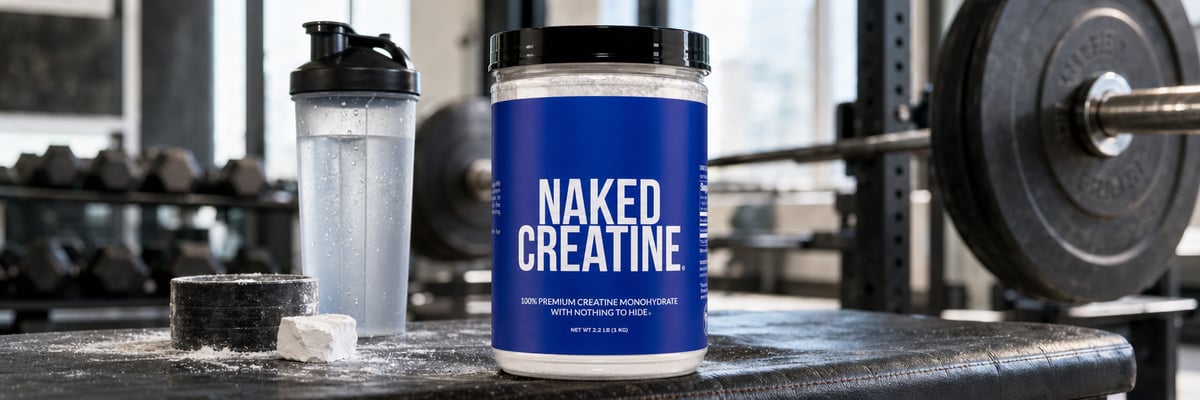
Naked Creatine is 100% pure creatine monohydrate with a single ingredient on the label. No artificial colors, no sweeteners, no fillers. It's unflavored, which means it mixes cleanly into anything and doesn't lock you into a taste you'll grow tired of. If you're looking for a clean, no-nonsense monohydrate that matches exactly what the research supports, it fits the criteria.
The supplement itself won't determine your results. Consistent daily dosing, adequate training intensity, and hitting your protein targets will. The creatine just needs to be real, pure, and taken every day.
Frequently Asked Questions
How long does creatine take to work?
Most people begin noticing performance improvements within 1–2 weeks of consistent creatine supplementation, though the exact timeline depends on your loading strategy. If you use a loading phase of 20g per day for 5–7 days, you can saturate your muscle creatine stores significantly faster than with a standard maintenance dose alone.
Does creatine work faster if you do a loading phase?
Yes — a loading phase of 20g per day (split into 4 doses) for 5–7 days can fully saturate your muscles with creatine in about a week, compared to 3–4 weeks with a standard 3–5g daily dose. After loading, you transition to a maintenance dose of 3–5g per day to keep your stores topped off. Both methods ultimately reach the same level of saturation; loading just gets you there faster.
When will I start seeing physical results like muscle growth?
Initial changes in body composition, such as water retention in the muscles, can appear within the first week of supplementation, giving muscles a fuller look. More meaningful gains in lean muscle mass typically become noticeable after 4–8 weeks of consistent training and supplementation combined, as creatine supports greater training volume over time.
Is creatine safe to take daily?
Creatine monohydrate is one of the most extensively researched sports supplements available and has a strong safety profile when taken at recommended doses. Long-term daily use of 3–5g has been studied for years without evidence of harm in healthy individuals, and organizations like the International Society of Sports Nutrition consider it safe for long-term use.
What is the best type of creatine to take?
Creatine monohydrate is the gold standard and the most research-backed form available, making it the most recommended option for the vast majority of people. While other forms like creatine HCl or buffered creatine exist, none have been shown to be significantly more effective than monohydrate when taken at equivalent doses.
Does it matter when during the day I take creatine?
Timing matters less than consistency — taking creatine daily is more important than taking it at a specific time. Some research suggests that taking creatine close to your workout, either pre- or post-exercise, may offer a slight edge in muscle uptake, but the overall difference is minimal compared to simply ensuring you take it every day.
Will creatine work if I don't exercise?
Creatine can still increase phosphocreatine stores in your muscles even without exercise, but the performance and muscle-building benefits are closely tied to resistance training or high-intensity exercise. Without the stimulus of regular training, you won't see meaningful gains in strength or muscle size, though some research does suggest creatine may support cognitive function and energy metabolism independently of exercise.
How do I know if creatine is actually working for me?
Common signs that creatine is working include improved performance during high-intensity exercise, the ability to push out more reps or lift heavier weights over time, and a slight increase in body weight due to intramuscular water retention. If you're not noticing any changes after 4–6 weeks of consistent use, check that you're hitting your daily dose of 3–5g and that your overall training program and nutrition are dialed in.
Top Product Picks
Chosen by 1 million+ customers. Free shipping on orders over $100.
Creatine Monohydrate Powder | Naked Creatine - 2.2LB
$35.99
- ✓ 100% premium creatine monohydrate
- ✓ Highest grade available: fast dissolving and quickly absorbed
- ✓ 5g of creatine per serving
- ✓ No artificial sweeteners, flavors, or colors

Orange Creatine Monohydrate Powder | Naked Creatine - 1.1LB
$29.99
- ✓ 100% premium creatine monohydrate
- ✓ Highest grade available: fast dissolving and quickly absorbed
- ✓ 5g of creatine per serving
- ✓ No artificial sweeteners, flavors, or colors

Strawberry Creatine Monohydrate Powder | Naked Creatine - 1.1LB
$29.99
- ✓ 100% premium creatine monohydrate
- ✓ Highest grade available: fast dissolving and quickly absorbed
- ✓ 5g of creatine per serving
- ✓ No Artificial Sweeteners, Flavors, or Colors