

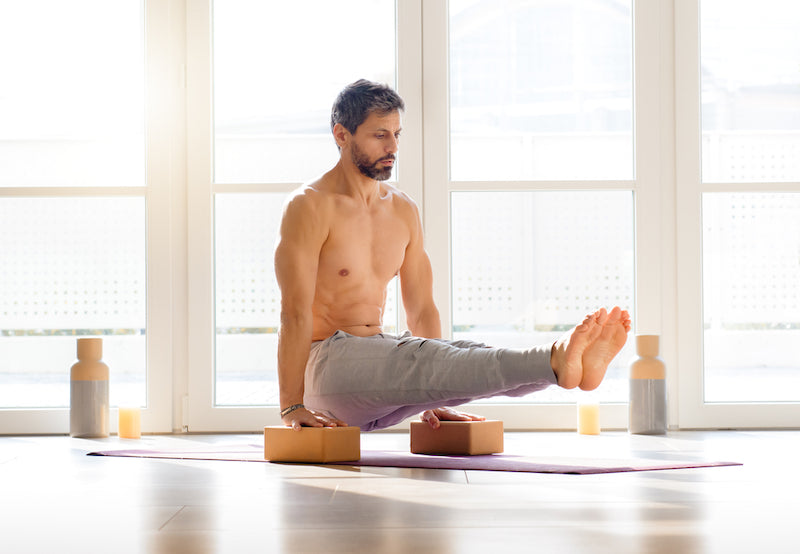
Hip flexors are a group of muscles located in the pelvic region that connect your legs to your torso.
These muscles are responsible for lifting your legs, bending at the hips, and maintaining balance.
Strong hip flexors are essential for athletes, particularly those who can benefit from explosive leg movements or quick changes of direction.
In this post, we'll explore the benefits and risks of weak hip flexors and provide you with the top three hip flexor exercises to strengthen this important muscle group.
Where are Hip Flexors Located?
Hip flexors are a group of muscles located in the front of your hips. The major hip flexor muscles include the iliopsoas, rectus femoris, and sartorius muscles.
What is the Function of a Hip Flexor?

The hip flexors allow you to…well…flex your hip joint and bring your thigh towards your torso.
They play a crucial role in various everyday movements such as walking, running, and climbing stairs.
The hip flexors are also responsible for maintaining balance and stability in the pelvis and spine. They are involved in the movement of tilting the pelvis forward, which can affect the curvature of the lower spine.
In addition to their role in everyday movements, strong hip flexors are especially important for athletes, as they can improve performance in sports such as running, jumping, and kicking.
Strong hip flexors can help increase stride length and power, improve explosive movements, and enhance overall agility and speed.
What are the Risks of Weak Hip Flexors?

Poor Posture
Weak hip flexors can cause an anterior pelvic tilt, which can lead to poor posture and lower back pain. An anterior pelvic tilt occurs when the pelvis tilts forward, causing the lower back to arch and the stomach to protrude.
Reduced Athletic Performance
Weak hip flexors can limit your athletic performance by decreasing your speed, agility, and power. They are especially important for movements such as running, jumping, and kicking.
Increased Risk of Injury
Weak hip flexors can increase your risk of injury, particularly in the lower back, hips, and knees. When the hip flexors are weak, other muscles and joints have to compensate for their lack of strength, which can lead to overuse injuries or strains.
Limited Range of Motion
Weak hip flexors can limit your range of motion, making it difficult to perform everyday movements such as walking, climbing stairs, and getting up from a seated position. This can also limit your ability to perform exercises and activities that require a wide range of motion.
Back Discomfort
Weak hip flexors can contribute to lower back issues, as they are responsible for stabilizing the pelvis and spine.
When they are weak, other muscles may have to compensate, leading to strain and pain in the lower back.
What are the Three Best Hip Flexor Exercises?

Hanging Leg Raises
This exercise is performed by hanging from a pull-up bar or other sturdy object and lifting your legs up towards your chest, using your hip flexors to initiate the movement.
Start by hanging from the bar with your hands shoulder-width apart and your legs straight.
Then, engage your core and use your hip flexors to lift your legs up towards your chest, keeping them straight.
Lower your legs back down to the starting position and repeat for the desired number of reps.
Single-Leg Romanian Deadlifts
This movement specifically targets the hip flexors of the standing leg.
Start by standing on one leg and hinging forward at the hips while keeping your back straight and your core engaged.
Hinge forward at the hips, keeping your back straight and your core engaged, and lift your non-standing leg behind you.
Lower your non-standing leg back down to the ground and return to the starting position.
Perform 8-12 reps for each side. 3-4 sets.
Psoas March
This exercise is performed by lying on your back and marching in the air with your legs.
To perform this exercise, lie on your back with your legs in table-top position.
Engage your core and hip flexors to pull one leg closer to your torso the other, and then straightening the other leg to send it away from your torso.
Switch legs and continue marching up and down while maintaining tension in your hip flexors. For extra resistance, you can add an exercise band.
Perform 10-15 reps on each leg for 3 sets.
How to Incorporate Hip Flexor Workouts Into Your Routine
For most people, the ideal approach would be to add one or two hip flexor sessions to your current routine, a couple of times a week.
So, instead of dedicating an entire session to hip flexors (because then it’ll mess up the rest of your routine), maybe do a 15-minute warmup that focuses on hip flexors before your leg day workout.
Or if you’re a runner, then perhaps you could also incorporate a quick hip flexor workout before or after your run.
The point is to find spots in your current routine where you could seamlessly add 15-20 minutes and a hip flexor workout would be congruent to your training for that day.
Bottom Line on Hip Flexors
In conclusion, hip flexor workouts are crucial for athletes and anyone looking to improve their overall fitness.
Strong hip flexors help improve athletic performance, reduce the risk of injury, and increase your range of motion.
By incorporating the three hip flexor exercises mentioned above into your workout routine, you'll be on your way to stronger hip flexors and a healthier, more functional body.