





Key Takeaways
- Clumping is normal: Protein powder clumps because it's hygroscopic — it naturally pulls moisture from the air. This is chemistry, not a quality defect.
- Not a spoilage signal: Clumping alone doesn't mean your protein has gone bad. Look for off smells, discoloration, or a bitter taste before discarding.
- Storage is the biggest factor: A cool, dry kitchen cabinet beats every other storage location. Humidity is the enemy.
- Liquid first, always: Adding powder to liquid — not the other way around — is the single easiest fix for clumpy shakes.
- Temperature matters: Cold water reduces protein solubility. Room temperature liquid mixes noticeably cleaner.
- Foam is harmless: Whey isolate foams because its proteins are surface-active. Let the shake rest for a minute and the foam settles.
- Cleaner ingredients behave differently: Minimal-ingredient protein powders without artificial thickeners may need slightly more attention to mixing but deliver better purity.

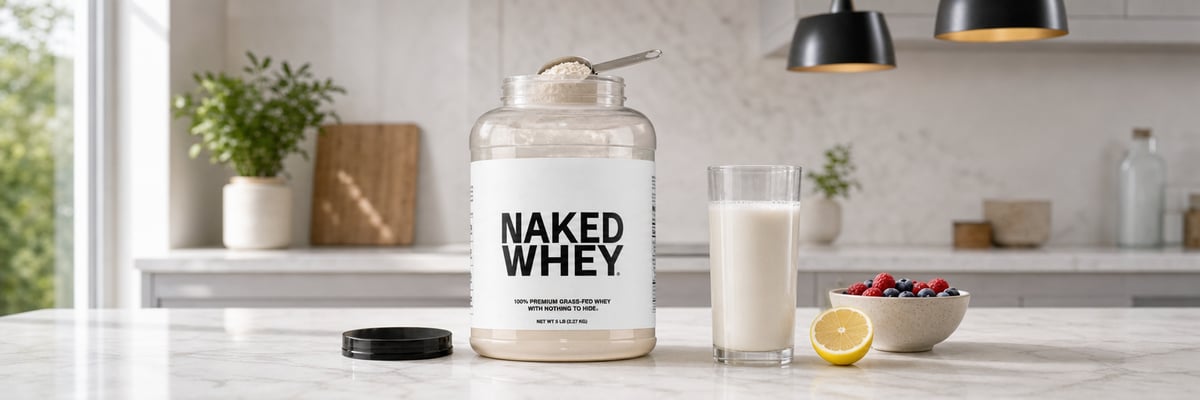
Grass Fed Whey Protein Powder | Naked Whey - 5LB
- Build and Maintain Lean Muscle Mass
- Boost Immune System
- Lose Fat
- Improve Heart Health
Why Does Protein Powder Clump? The Real Reasons
You open your protein powder, scoop it into your shaker, and pull out a solid mass of compressed powder instead of a clean serving. If you've asked yourself why does my protein powder clump, you're not alone — and your powder almost certainly isn't ruined. Clumping is one of the most common complaints among protein powder users, and in the vast majority of cases it's completely fixable.
The core causes fall into a few clear categories: moisture exposure, storage conditions, liquid temperature, mixing method, and ingredient composition. Moisture is the main culprit. Protein powder is hygroscopic, meaning it actively attracts water molecules from its surrounding environment. Even the small burst of humid air that enters the container every time you open it is enough to start the process over time.
The good news is that understanding why clumping happens makes it easy to prevent. This guide covers the science behind it, how to tell if your powder has actually gone bad, the best storage practices, step-by-step mixing techniques, and what to look for when choosing a protein powder that mixes well from the start.
Clumping is a texture issue, not a nutrition issue. Your protein content, amino acid profile, and macros are not affected by clumps in the container.
The Science Behind Why Protein Powder Clumps

Protein powder particles are porous and carry an electrostatic charge that draws ambient moisture toward them. Once water molecules are absorbed, the particles become sticky and begin bonding to neighboring particles — forming the dense, hard clumps you find at the bottom of the container. This process accelerates in warm or humid environments where there's simply more water vapor in the air.
- Whey concentrate: Higher fat and lactose content gives it a slightly more forgiving texture, but it still clumps with moisture exposure.
- Whey isolate: More refined and lower in fat, which can make it finer in texture and quicker to absorb moisture — but it also disperses faster in liquid when mixed correctly.
- Casein: Thicker by nature due to its micellar structure. It gels in liquid and tends to clump more aggressively, especially in cold water.
- Plant-based proteins (pea, brown rice): Coarser particle size and higher fiber content make them more prone to clumping and harder to fully dissolve.
Many commercially processed protein powders contain lecithin — derived from soy or sunflower — as an emulsifier. Lecithin has both water-attracting and fat-attracting molecular ends, which helps protein particles disperse more readily in liquid. Research published in the Journal of Food Science and Technology [1] confirms that emulsifiers like lecithin significantly improve the dispersibility of dairy-based powders.
Naked Nutrition's protein powders use minimal ingredients without artificial emulsifiers or thickeners. That means you're getting a cleaner product — but one that rewards proper mixing technique and good storage habits more than a heavily processed alternative would. It's a reasonable trade-off: fewer additives, more attention to how you prepare it.
Does Clumping Mean Your Protein Powder Has Gone Bad?

Clumping by itself is not a sign of spoilage. Protein powder clumps when it absorbs moisture — that's a physical reaction, not a biological one. The powder is almost always still safe and fully effective. Before you throw anything out, check for the actual warning signs of a protein powder that has genuinely expired or gone rancid.
Discard your protein powder if you notice any of the following:
- A foul, sour, or off smell that wasn't there when you first opened it
- Visible discoloration or dark spots
- A bitter or rancid taste
- Unusual or slimy texture after mixing
- The expiration date has passed and any of the above signs are present
Most protein powders carry a shelf life of one to two years, though this varies depending on ingredient composition. Powders with added carbohydrates, fats, or natural flavors tend to degrade faster than unflavored, single-ingredient options. A study in the Journal of Dairy Science [2] found that the Maillard reaction — a chemical process between amino acids and sugars — accelerates at higher temperatures and can reduce the bioavailability of key amino acids like lysine in stored protein powders over time.
📊 What Research Says
According to Smith et al. (2017) in the Journal of Dairy Science [2], protein powders stored at elevated temperatures showed measurable losses in lysine availability due to the Maillard reaction — with degradation accelerating significantly beyond 25°C (77°F). This is why storage temperature matters not just for clumping, but for nutritional integrity over the long term.
If the expiration date hasn't passed and the powder smells and tastes normal, clumps are a texture problem — not a nutrition problem. Break them up and use the powder as normal.
How to Store Protein Powder to Prevent Clumping
Where you keep your protein powder makes a bigger difference than most people realize. The core rule is simple: cool, dry, and dark. A kitchen cabinet away from the stove is close to ideal for most people. It's consistently cool, shielded from direct light, and far from the steam and temperature fluctuations that cooking generates.
These are the storage spots to avoid:
- The bathroom: Showers create persistent humidity. Even a closed cabinet near a shower absorbs more moisture than you'd expect.
- Near the stove or oven: Heat accelerates both moisture absorption and the Maillard reaction that degrades amino acids.
- Windowsills or countertops with sun exposure: Temperature swings and UV exposure break down both the protein and any added vitamins.
- The garage: Temperature extremes in either direction accelerate degradation.
Always seal the lid tightly after every single use. Even a few seconds of exposure to warm, humid kitchen air adds up over weeks of daily scooping. If you live in a particularly humid climate, add a food-safe silica gel desiccant packet inside the container. These are inexpensive and absorb excess moisture before it reaches the powder.
Refrigerating protein powder seems logical but actually introduces a new problem: condensation. Every time you remove the cold container into a warm room, water vapor condenses on the inner walls and drips into the powder. If you insist on refrigerating it, use a fully airtight container and allow it to come to room temperature before opening. Transferring powder to a high-quality airtight container is also smart if the original resealable bag or lid doesn't create a tight seal.
How to Fix and Prevent Clumps When Mixing Your Protein Shake

Even well-stored protein powder can clump during mixing if the technique is off. The single most important rule: liquid first, powder second. Adding powder to an empty shaker and then pouring liquid on top forces the powder to compact at the bottom. Starting with liquid gives the powder something to disperse into immediately.
If you already have clumps in the container, break them up before scooping. Use a fork to loosen the powder, or sift the serving through a mesh strainer directly into your shaker. Adding hard clumps whole to liquid almost guarantees they survive the shake intact.
Here's how mixing tools rank for getting a smooth result:
- Blender: Best results. Start on low to incorporate the powder, then increase speed for 20 to 30 seconds. Avoids over-aerating the protein.
- Shaker bottle with wire whisk ball: Reliable and portable. Add liquid first, add powder, shake vigorously for 20 to 30 seconds, then let it rest briefly to settle.
- Milk frother: Surprisingly effective for single servings. Move it slowly through the liquid to minimize foam.
- Fork: Works in a pinch for thin servings. Not recommended for casein or plant-based proteins.
- Spoon alone: Avoid this entirely. It doesn't generate enough shear force to break up clumps.
Temperature is often the overlooked variable. Cold liquid reduces the solubility of protein particles, which is why shakes mixed with ice water so often have stubborn clumps. Room temperature or slightly warm liquid disperses the same powder noticeably more cleanly. If you prefer a cold shake, mix with room temperature liquid first, then add ice.
Why Does Whey Protein Isolate Get Foamy — and How to Reduce It
Foam and clumping are separate issues, though they often get blamed on the same thing. Clumps come from moisture binding particles together before mixing. Foam happens during mixing, when vigorous agitation forces air into the liquid and the surface-active proteins trap it there.
Whey protein isolate is particularly surface-active. They have hydrophobic (water-repelling) regions that orient themselves toward air bubbles when the liquid is shaken, forming a stable foam layer. Research published in Food Hydrocolloids [3] confirms that whey protein concentrate and isolate both exhibit strong foaming capacity due to this amphiphilic molecular structure.
Foam is harmless. It doesn't affect the protein content, amino acid profile, or how your body absorbs it. But it can make a shake less enjoyable to drink. Here's how to minimize it:
- Use room temperature liquid instead of cold water
- Mix more slowly and don't over-agitate
- Let the shake rest for one to two minutes before drinking — the foam collapses on its own
- Mix your shake before your workout and let it settle during your warm-up
- Avoid shaking with a nearly-full container, which creates more turbulence
Purer whey isolate powders without added thickeners or anti-foaming agents tend to foam more than heavily processed alternatives. This is actually a sign of quality. If you want to reduce foam without compromising purity, technique is your best tool — not a more processed product.
Choosing a Protein Powder That Mixes Well

Not all protein powders behave the same in liquid, and ingredient quality is the primary reason. Powders loaded with artificial thickeners, gums, and anti-caking agents are engineered to dissolve easily regardless of technique. That's convenient, but those additives add nothing nutritionally and may cause digestive discomfort for some people.
Clean-label powders with minimal ingredients require slightly more intentional mixing — liquid first, right temperature, a proper shaker or blender. In exchange, you get a product where every gram of weight is working for your nutrition goals, not just improving the pour.
Naked Nutrition's protein lineup is built around this philosophy. Each product uses as few ingredients as possible without sacrificing performance:
- Naked Whey: 100% grass-fed whey concentrate with one ingredient. Best for general protein goals and smoothie-style shakes.
- Naked Whey Isolate: Ultra-filtered whey isolate with higher protein per serving and lower lactose. Ideal for those who are lactose-sensitive.
- Naked Casein: Slow-digesting micellar casein for sustained amino acid release. Mix with slightly warmer liquid for best results given its thicker texture.
- Naked Pea Protein: A complete plant-based option from yellow peas. Requires more vigorous mixing than whey due to coarser particle size.
Third-party testing is another factor worth checking before you buy. Independent lab verification confirms that what's on the label is what's in the container — including the absence of contaminants that can affect both taste and texture. Naked Nutrition products are third-party tested for this reason. When a powder mixes poorly and tastes off, it's often a formulation issue that transparency-focused brands avoid from the start.
Frequently Asked Questions
Why does my protein powder clump when I mix it with liquid?
Protein powder clumps because the powder particles absorb liquid unevenly, forming hydrated clusters before they can fully disperse. This happens fastest when you add liquid to powder instead of powder to liquid, or when you mix too slowly. A shaker bottle with a wire whisk ball or a blender solves the problem in seconds.
Why is my protein powder already clumped inside the container before I even open it?
Moisture is the culprit. Protein powder is hygroscopic, meaning it actively pulls water vapor from the surrounding air, and that moisture binds particles together into solid clumps. Temperature swings, storing the container near a stove or window, or repeatedly scooping with a wet spoon all accelerate this. Store your powder in a cool, dry place with the lid sealed tightly after every use.
Does clumping mean my protein powder has gone bad?
Not automatically. Clumping from moisture exposure is a texture issue, not a spoilage issue, and the protein itself is usually still fine. Check for a sour or rancid smell, visible mold, or a color change before deciding to discard it. If it smells and looks normal, break up the clumps and use it.
Does protein powder with fewer additives clump more easily?
Yes, and that's a trade-off worth understanding. Many commercial protein powders include anti-caking agents like silicon dioxide or soy lecithin specifically to prevent clumping and improve mixability. Cleaner, shorter-ingredient-list powders skip those additives, so they're more susceptible to moisture and may require more vigorous shaking. The clumping is a sign of a simpler formula, not a defect.
What's the best way to mix protein powder to avoid clumps?
Add your liquid to the shaker bottle first, then add the protein powder on top. This prevents dry powder from compacting against the bottom before it has a chance to hydrate. Shake vigorously for 20 to 30 seconds with a whisk ball, or blend for 15 seconds if you want a completely smooth result.
Does the type of protein affect how much it clumps?
It does. Whey protein concentrate tends to clump more than whey protein isolate because it retains more fat and moisture from processing. Casein powder is particularly prone to clumping because of how it gels when it contacts liquid. Plant-based proteins like pea or rice protein can vary widely depending on how finely they're milled and whether lecithin is added.
How should I store protein powder to prevent clumping?
Keep your container in a cool, dry location away from direct sunlight, heat sources, and humid environments like above the stove or near a dishwasher. Always use a dry scoop and seal the lid completely after each use. If you live in a humid climate, adding a food-safe silica gel desiccant packet to the container helps absorb excess moisture between uses.
Can clumped protein powder lose its nutritional value?
Clumping caused purely by moisture doesn't significantly degrade the amino acid profile or protein content. However, prolonged moisture exposure can eventually promote oxidation of fats in concentrate-based powders or create conditions where bacteria can grow. Use clumped powder promptly, and if the container has been exposed to a lot of moisture over a long period, trust your nose and eyes before you trust the expiration date.
Top Product Picks
Chosen by 1 million+ customers. Free shipping on orders over $100.

Egg White Protein Powder | Naked Egg - 3LB
$79.99
- ✓ From non-GMO eggs exclusively from US farms
- ✓ Processed from fresh eggs into powder in under one day to retain a complete amino acid profile
- ✓ 25g of protein and 5.8g of BCAA's per serving
- ✓ Zero sugar

Pea Protein Powder | Naked Pea - 5LB
$57.99
- ✓ Sustainable Farming Practices
- ✓ Superior Amino Acid Profile
- ✓ Promote Muscle Gain
- ✓ Lose Weight

Micellar Casein Protein Powder Supplement - 5LB
$109.99
- ✓ Why Micellar Casein Protein
- ✓ Promote Muscle Growth While You Sleep
- ✓ Improve Body Composition