




On this page
Creatine Monohydrate vs HCL: Which Form Is Right for You?
Two popular forms of creatine promise big results, but key differences in solubility, dosage, and cost could determine your perfect match.

Key Takeaways
- Both forms work: Creatine monohydrate and creatine HCL both increase strength, training volume, and muscle mass in resistance-trained athletes.
- Monohydrate has the research edge: Decades of human trials back creatine monohydrate. The ISSN recognizes it as the most effective ergogenic nutritional supplement for high-intensity exercise.
- HCL has a solubility edge: Creatine HCL dissolves more readily and is associated with less bloating and water retention, making it a practical option for GI-sensitive athletes.
- Dosing differs: Monohydrate typically requires a loading phase (20g/day for 5–7 days) followed by a 3–5g maintenance dose. HCL is commonly used at 1–2g daily with no loading phase.
- Budget matters: Creatine monohydrate costs significantly less per serving. Always compare cost-per-serving, not sticker price.
- Consistency beats timing: Taking creatine daily, at any time, matters more than whether you take it pre- or post-workout.

Creatine Monohydrate Powder | Naked Creatine - 2.2LB
- Free Shipping Included
- Creatine Monohydrate
- Creatine Formula
- Evidence-Based Formulas
Creatine Monohydrate vs HCL: What's the Difference?

You've decided to add creatine to your stack. Now you're staring at two options on the shelf: creatine monohydrate and creatine HCL. One is cheaper and backed by 30 years of research. The other promises better absorption, fewer side effects, and a smaller dose. Which one is actually worth your money?
This article answers that question directly. You'll get a clear breakdown of how each form works, what the research actually says about performance and muscle growth, how dosing compares, and who each form suits best. No hype, no vague claims.
The short version: creatine monohydrate vs HCL is not a debate with a single winner. Both forms are effective. The right choice depends on your budget, your digestive tolerance, and how much stock you place in long-term human trial data. The sections below give you everything you need to make that call.
📊 What Research Says
A 2017 position stand from Kreider et al. in the Journal of the International Society of Sports Nutrition identified creatine monohydrate as the most effective ergogenic nutritional supplement currently available for athletes seeking to increase high-intensity exercise capacity and lean body mass.
What Is Creatine and How Does It Work?

Creatine is a nitrogenous organic acid synthesized in the body from three amino acids: L-arginine, glycine, and L-methionine. It's not a protein, but it's built from the same building blocks. According to the National Institutes of Health (2022), roughly 50% of the body's creatine supply is produced endogenously by the liver, pancreas, and kidneys. The other 50% comes from dietary sources, primarily red meat and fish.
Inside the body, creatine is stored primarily as phosphocreatine, a creatine molecule bonded to a phosphate group. That phosphate connection is the key to understanding why creatine matters for performance. ATP, adenosine triphosphate, is the energy currency your muscle cells spend during exercise. When ATP loses a phosphate group to generate energy, it becomes ADP. Phosphocreatine donates its phosphate back to ADP, regenerating ATP rapidly, as noted by research published in Sports Medicine Open (2018).
About 95% of the body's creatine is stored in skeletal muscle, with the remaining 5% concentrated in the brain. That distribution explains why creatine research has historically focused on exercise performance, though emerging work on cognitive function is growing.
- Muscle cells burn ATP to generate force during explosive exercise like lifting or sprinting
- ATP is depleted within seconds at maximum intensity — phosphocreatine regenerates it almost instantly
- Higher creatine stores mean more ATP can be regenerated between reps and sets
- Supplementing with creatine increases total phosphocreatine stores, extending your capacity for high-intensity output
This is why creatine supplementation consistently shows up in the research on strength and power sports. It's not stimulating your nervous system or changing your hormones. It's filling the fuel tank so your muscles can sustain more work before fatiguing, as confirmed by research in the International Journal of Sport Nutrition and Exercise Metabolism (2019).
Creatine Monohydrate: Benefits, Dosage, and Side Effects

Creatine monohydrate is creatine bonded to a single water molecule. That's what "monohydrate" means: mono for one, hydrate for H2O. It's the form used in the overwhelming majority of human clinical trials, and the ISSN position stand (Kreider et al., 2017) explicitly names it the benchmark for all other creatine forms. When someone says "creatine works," they almost always mean this form.
Standard dosing follows a two-phase protocol. The loading phase involves 20g per day split into four 5g doses over 5–7 days. This saturates muscle creatine stores quickly. The maintenance phase drops to 3–5g per day to sustain those elevated stores. Skipping the loading phase is an option — you'll reach full saturation in 3–4 weeks at 3–5g daily — but loading gets you there faster.
The documented benefits include meaningful increases in strength, training volume, and lean mass. Research published in the Journal of Strength and Conditioning Research (2020) confirmed improvements in muscle recovery after resistance training. Creatine monohydrate also draws water into muscle cells, which may improve cell hydration and functional performance according to Sports Medicine (2017).
The side effects are real but manageable. Bloating, water retention, and GI discomfort are the most commonly reported, particularly during the loading phase. These symptoms typically resolve once loading ends and maintenance begins. One practical fix: micronized creatine monohydrate, which is ground into finer particles, dissolves more easily and causes fewer digestive complaints without changing the core compound.
- Pros: Most researched form available, proven across dozens of human trials, cost-effective, widely available in multiple formats
- Cons: Loading phase can cause temporary bloating and water retention, larger serving size than HCL
Creatine HCL: Benefits, Dosage, and Side Effects

Creatine HCL, or creatine hydrochloride, is creatine bonded to a hydrochloride group rather than a water molecule. That structural difference has two practical consequences: greater solubility in water and a reduced tendency to pull water into surrounding tissue. A study by Gufford et al. (2010) found creatine HCL is approximately 38 times more soluble than creatine monohydrate, which explains why it mixes cleanly in smaller volumes of liquid.
The commonly recommended dose for creatine HCL is 1–2g per day, significantly lower than monohydrate's 3–5g maintenance dose. The rationale is that higher solubility may translate to more efficient uptake at lower amounts. That said, this hasn't been conclusively demonstrated in large-scale human trials. The dose difference is promising, but "may require less" is not the same as "proven to be equally effective at a lower dose."
No loading phase is typically recommended with creatine HCL. Whether that's because the kinetics genuinely differ or because the research base is simply thinner isn't yet clear. Most practitioners who recommend HCL do so based on the solubility data and anecdotal reports of better tolerability.
The reduced bloating profile is where HCL has its clearest advantage. Without the water molecule attached, and with lower doses generally required, water retention and GI discomfort are less common. For athletes who quit creatine monohydrate because of digestive issues, HCL is a practical alternative worth trying.
- Pros: Greater solubility, smaller serving size, less bloating and water retention, no loading phase typically required
- Cons: Limited large-scale human trial data, higher cost per gram, benefits not yet confirmed at scale
Creatine Monohydrate vs HCL: Head-to-Head Comparison

The performance data on creatine monohydrate is extensive. A review compiling 22 studies on creatine supplementation combined with resistance training, published in the Journal of Strength and Conditioning Research (2018), found that creatine increased maximum strength by an average of 8% more than placebo. Subjects taking creatine averaged 20% improvement in 1RM, 3RM, or 10RM lifts, versus 12% in training-only controls. Training volume also improved, with creatine users completing an average of 14% more reps at a given intensity compared to controls.
Direct comparisons between the two forms are fewer but informative. A study published in Nutrition Research (2021) measured strength, body composition, and anabolic hormones in subjects taking either creatine monohydrate or creatine HCL over eight weeks. Both groups improved in muscle strength, lean mass, cross-sectional muscle area, and anabolic hormone levels. Neither form outperformed the other. The takeaway: when matched in study conditions, both deliver similar outcomes.
📊 What Research Says
A study in Food and Nutrition Science tested four groups over four weeks: 5g monohydrate, 5g HCL, 1.5g HCL, and a control. All creatine groups gained strength. Only the creatine HCL groups showed fat mass reduction, and lean mass increased only in the higher-dose HCL group. The result is intriguing, but the sample size was small (40 subjects) and the study was four weeks long. More research is needed before this becomes a firm recommendation.
| Factor | Creatine Monohydrate | Creatine HCL |
|---|---|---|
| Research backing | Extensive (30+ years of human trials) | Limited (mostly animal or small human studies) |
| Typical daily dose | 3–5g (maintenance); 20g (loading) | 1–2g (no loading typically required) |
| Solubility | Moderate | High (approx. 38x more soluble) |
| Bloating risk | Moderate, especially during loading | Low |
| Cost per serving | Lower | Higher |
| Availability | Widely available in all formats | Less common, fewer product options |
| Best for | Budget-conscious athletes, maximum research confidence | GI-sensitive athletes, those avoiding loading |
Neither form is definitively superior. Creatine monohydrate has the evidence base, the cost advantage, and the established dosing protocols. Creatine HCL has a tolerability advantage and may appeal to athletes who want a smaller, cleaner-mixing dose. What the current research doesn't support is the claim that HCL is significantly more effective than monohydrate at matched doses, despite the body composition findings from one small study.
Which Creatine Should You Choose?

For most athletes, creatine monohydrate is the starting point. It has the most robust evidence, the lowest cost per serving, and a well-established dosing protocol. If you tolerate it well, there's no compelling reason to switch. The ISSN position stand (Kreider et al., 2017) doesn't hedge on this: monohydrate is the benchmark form and the one against which all others are measured.
If you've tried monohydrate and experienced consistent bloating, GI discomfort, or water retention that bothered you enough to stop taking it, creatine HCL is a legitimate alternative. The reduced bloating profile is real, and athletes who couldn't stick with monohydrate often report better compliance with HCL. Compliance matters. A supplement you actually take consistently beats a theoretically superior one you abandon.
Here's a simple decision framework:
- Budget-conscious athlete: Creatine monohydrate. Lower cost per serving, identical access to the full body of research.
- GI-sensitive athlete: Creatine HCL. Smaller dose, less water retention, no loading phase required.
- Maximum research backing: Creatine monohydrate. Decades of human trials at every performance level.
- Prefer to skip loading: Creatine HCL, or simply skip the loading phase with monohydrate and reach saturation in 3–4 weeks instead.
When evaluating any creatine product, look for transparent labeling that lists the exact dose and form. Third-party testing for purity and contaminants matters. Avoid products with unnecessary fillers, artificial colors, or proprietary blends that obscure the actual creatine content. Compare cost-per-serving, not the price of the container.
On timing: research does not show a meaningful performance difference between taking creatine pre- or post-workout. What the data does show is that consistency, taking creatine every day, drives muscle saturation and results. Pick a time in your routine that you'll actually stick to and stay with it.
- Single-ingredient formula: creatine only, no fillers or proprietary blends
- Transparent labeling: exact dose and form listed on the label
- Third-party tested for purity, heavy metals, and contaminants
- No artificial colors, sweeteners, or anti-caking agents
- Cost-per-serving, not total bottle price, is the right number to compare
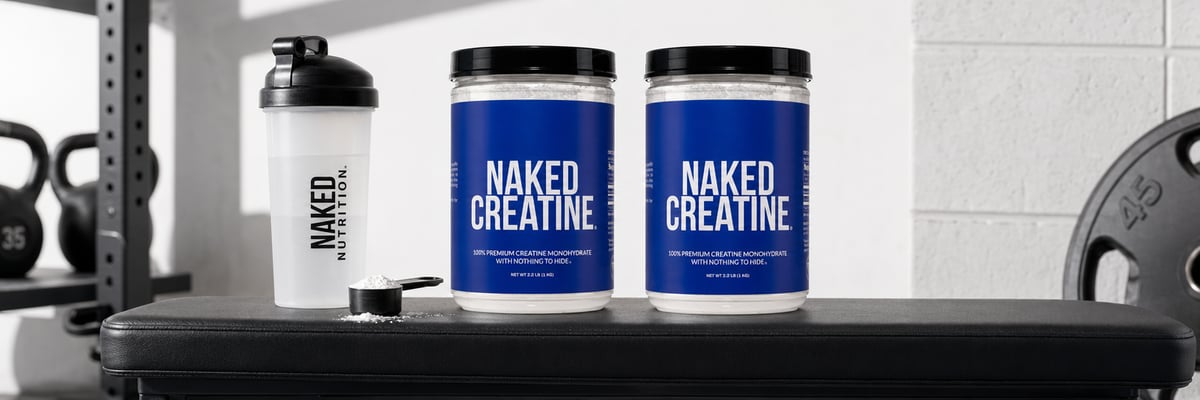
Naked Nutrition's creatine monohydrate is a single-ingredient product with no additives, no fillers, and straightforward dosing, exactly what you want from a creatine supplement. If you're starting with creatine or switching back from a more complex product, it's a clean, cost-effective option that delivers what the research supports.
Frequently Asked Questions
What is the main difference between creatine monohydrate and creatine HCL?
Creatine monohydrate is creatine bound to a water molecule, making it the most researched and widely used form of creatine available. Creatine HCL (hydrochloride) is creatine bound to a hydrochloric acid group, which increases its solubility in water and may improve absorption in the digestive tract. Both forms ultimately deliver creatine to your muscles, but they differ in dosage, solubility, and the volume of scientific evidence supporting their use.
Which form of creatine is more effective for building muscle and strength?
Creatine monohydrate has decades of peer-reviewed research confirming its effectiveness for increasing muscle mass, strength, and high-intensity exercise performance. While creatine HCL shows promise and may be equally effective at lower doses, it simply does not have the same volume of clinical evidence behind it. For most people focused on proven results, creatine monohydrate remains the gold standard.
Do I need to do a loading phase with creatine HCL like I do with monohydrate?
A loading phase with creatine monohydrate — typically 20 grams per day split into four doses for five to seven days — is optional but can accelerate muscle saturation. Because creatine HCL is absorbed more efficiently, most manufacturers suggest that a loading phase is not necessary, and a smaller daily maintenance dose is sufficient. However, skipping the loading phase with either form simply means it may take three to four weeks to fully saturate your muscles.
Why does creatine monohydrate cause bloating but creatine HCL does not?
Creatine monohydrate draws water into muscle cells, which can cause some users to experience mild water retention, bloating, or GI discomfort, particularly during a loading phase. Creatine HCL's higher solubility means it dissolves more readily in the stomach and is absorbed before it can cause osmotic stress in the gut, reducing the likelihood of bloating. If you've struggled with digestive side effects from monohydrate, HCL may be a more comfortable alternative.
How do the recommended doses compare between creatine monohydrate and creatine HCL?
The standard maintenance dose for creatine monohydrate is 3 to 5 grams per day, with a loading phase of up to 20 grams per day if desired. Creatine HCL is typically dosed at around 1 to 2 grams per day due to its superior solubility and absorption rate. This means you can take a smaller serving of HCL and potentially achieve similar muscle saturation compared to a larger serving of monohydrate.
Is creatine HCL safe to take daily, and are there any known side effects?
Creatine HCL is generally considered safe for healthy adults when taken at recommended doses, with no major adverse effects reported in the available research. Like monohydrate, it is not recommended in excessive amounts, and anyone with pre-existing kidney conditions should consult a healthcare provider before supplementing with any form of creatine. Staying well hydrated when taking any creatine supplement is always advisable to support kidney function and overall performance.
Which form of creatine offers better value for money?
Creatine monohydrate is significantly more affordable than creatine HCL on a per-serving basis, largely because it has been manufactured at scale for decades and requires a straightforward production process. While creatine HCL costs more per gram, its lower effective dose means the price difference per daily serving may be smaller than it first appears. For budget-conscious consumers who have no issues tolerating monohydrate, it remains the most cost-effective choice on the market.
Does Naked Nutrition creatine monohydrate use any third-party testing or certifications?
Naked Nutrition's creatine monohydrate is made with Creapure, a premium creatine ingredient produced in Germany that is independently tested for purity and free from banned substances. This makes it a trustworthy option for competitive athletes who are subject to drug testing and need assurance about what is in their supplements. Choosing a product with third-party certification or a verified ingredient like Creapure ensures you are getting a clean, accurately dosed product without unwanted additives.
Top Product Picks
Chosen by 1 million+ customers. Free shipping on orders over $100.
Creatine Monohydrate Powder | Naked Creatine - 2.2LB
$35.99
- ✓ 100% premium creatine monohydrate
- ✓ Highest grade available: fast dissolving and quickly absorbed
- ✓ 5g of creatine per serving
- ✓ No artificial sweeteners, flavors, or colors

Lemon Lime Creatine Monohydrate Powder | Naked Creatine - 1.1LB
$29.99
- ✓ 100% premium creatine monohydrate
- ✓ Highest grade available: fast dissolving and quickly absorbed
- ✓ 5g of creatine per serving
- ✓ No artificial sweeteners, flavors, or colors

Strawberry Creatine Monohydrate Powder | Naked Creatine - 1.1LB
$29.99
- ✓ 100% premium creatine monohydrate
- ✓ Highest grade available: fast dissolving and quickly absorbed
- ✓ 5g of creatine per serving
- ✓ No Artificial Sweeteners, Flavors, or Colors